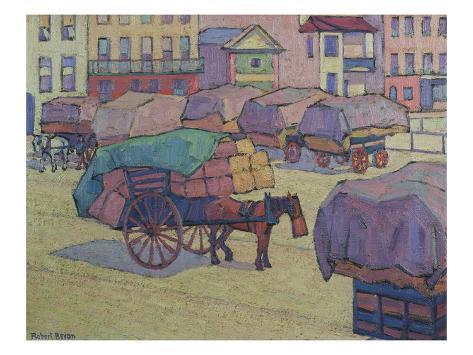
 Cumberland Market was on Chester Terrace. It adjoined the basin of Regent's Canal, before it was filled with rubble from buildings damaged in the Second World War. The market was part of a complex of buildings,
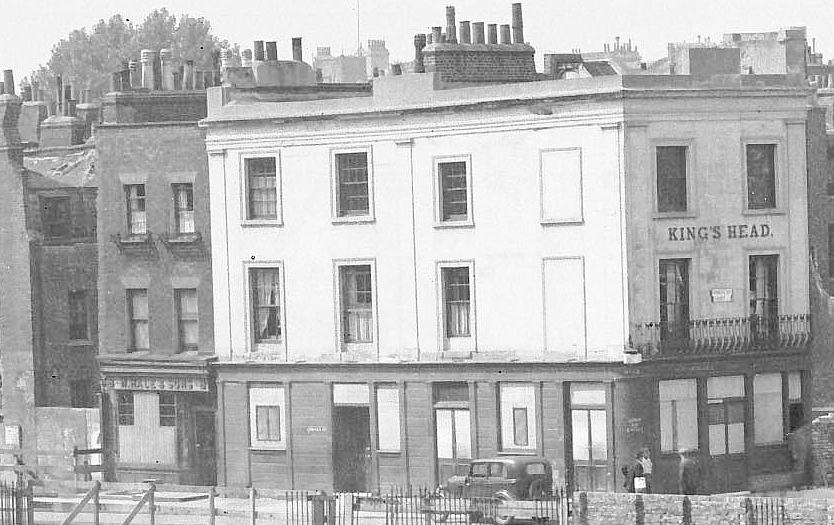 markets, shops and small houses that serviced the grand terraces facing Regent's Park. The site is now part of a Crown Estate. In 1910, around the time Robert Bevan completed this charcoal drawing, Cumberland Market was used for the sale of hay and straw. Bevan's bold sketch shows the stalls covered in tarpaulins. In 1910, lifes
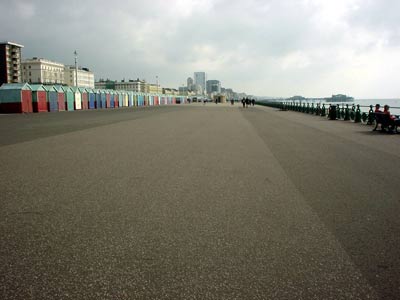
 He was born in Brunswick Square, Hove
 , near Brighton,
 the fourth of six children of Richard Alexander Bevan and Laura Maria Polhill. T
he Bevans had been a Quaker family with long associations with Barclays Bank.
 They were descended from Silvanus Bevan the Plough Court apothecary and Robert Barclay the Quaker Apologist. T
he family, who could trace direct descent from Iestyn ap Gwrgant,
 had left Wales in the 17th century and settled in London.

 potteries. In 1888 he studied art under Fred Brown at the Westminster School of Art before moving to the Académie Julian in Paris.
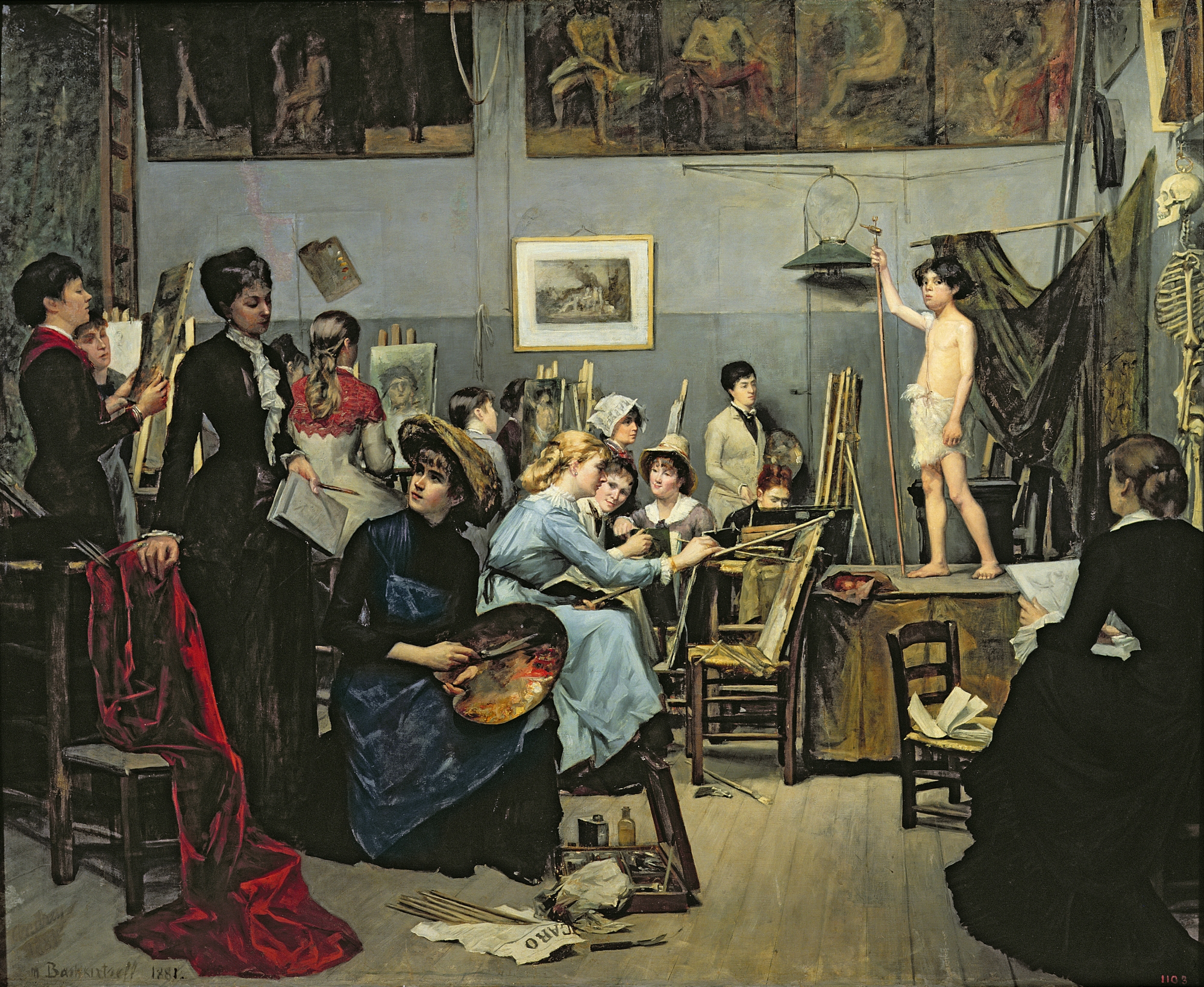 Amongst his fellow students were Paul Sérusier,
 Pierre Bonnard, Edouard Vuillard and Maurice Denis
 . Bevan made his first visit to Brittany with a fellow student Eric Forbes-Robertson in 1890 and stayed at the Villa Julia, in Pont-Aven.
 He made a second visit in the autumn of the following year before travelling to Morocco by way of Madrid to study Velasquez and Goya at first hand. He appears to have done more fox-hunting in Tangier
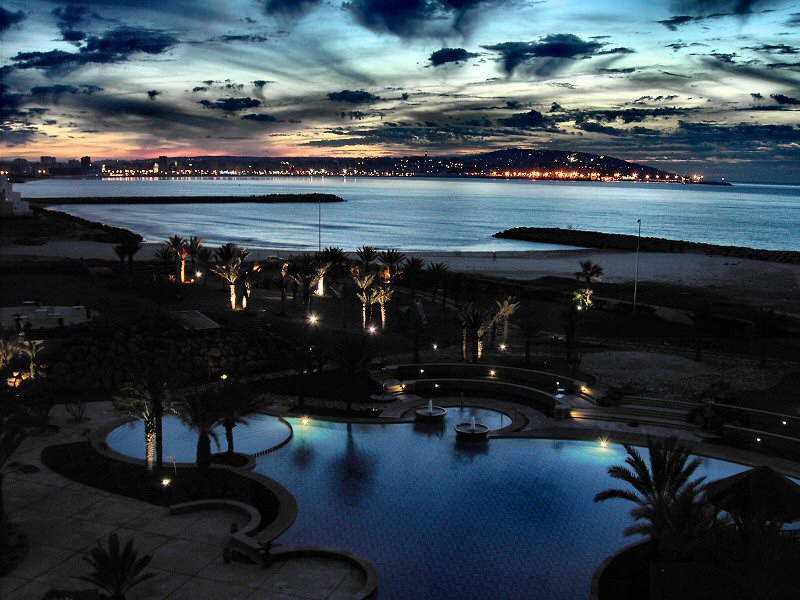 than drawing in the company of the artists Joseph Crawhall and George Denholm Armour and was Master of the Tangier Hunt in his second season.
Bevan returned to Brittany in 1893. There is no evidence that he had ever met Van Gogh but it is obvious in the swirling trees and landscape of his Breton drawings that he knew his work. It is known that he was friendly with Paul Gauguin, who gave him several prints. Bevan also received encouragement from Renoir, particularly in his drawing of horses. Although not evident in the few paintings that survive from this period it is in his drawings, early prints and two surviving wax panels that the obvious influence of Pont-Aven synthetism can be seen.
On his return to England in 1894 Bevan went to live on Exmoor
 where he was able to combine painting with hunting.
Breton Mother and Child, c. 1894.
 Stanisława de Karłowska
  at the wedding of Polish art student Eric Forbes-Robertson in Jersey. At the end of the year Bevan and de Karłowska married in Warsaw. Her father had extensive land in central Poland and for the remainder of their married life they would make long summer visits there.
In 1900 the Bevans settled in London at 14 Adamson Road, Swiss Cottage.
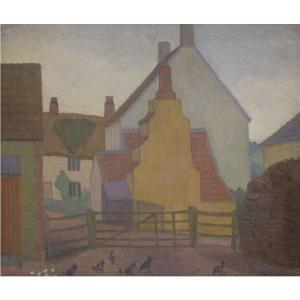
 Between 1900 and 1922, Bevan lived at 14 Adamson Road, Swiss Cottage, in a house with a top floor studio built for Sir Alfred East. He painted a number of views in the neighbouring suburbs of Belsize Park and St John's Wood. This painting, which has been dated 1918, probably shows Queen's Grove, St John's Wood, though the anonymity of the scene is deliberateTheir first child, Edith Halina (Mrs Charles Baty), had been born in December 1898 and their second, Robert Alexander, in March 1901.
The summers of 1901, 1903 and 1904 were spent in Poland and it was here that some of his most colourful work was produced. The influence of Gauguin was a key role in Bevan's development, helping him to discover the pure colour which led him to a premature Fauvism in 1904. His Courtyard o
 f that year has been described as “one of the first exercises in the expressive use of pure colour in this century”.Bevan's early experiments in colour can also be seen in his The Mill Pool which recalls the Talisman picture that Serusier painted to Gauguin's instructions and was described as being “quite different in colour and really rather superior”.
 However his first one-man exhibition in 1905, which contained probably the most radical paintings by a British artist at that time, was not a commercial success and was hardly noticed by the critics. "B
evan evidently lost confidence in the direction it pointed and never again produced so outstanding a painting of this type. Sir Philip Hendy, in his preface to the 1961 Bevan retrospective exhibition at Colnaghi's, commented that Bevan was perhaps the first Englishman to use pure colour in the 20th Century. He was certainly far in advance of his Camden Town colleagues in this respect."

In the same year Bevan submitted five works to the first Allied Artists’ Association in London’s Albert Hall—a non-juried, subscription show founded by Frank Rutter
 to promote progressive artists and based on the French Salon des Indépendants.(Wassily Kandinsky showed in England for the first time at the second exhibition in 1909.)
Having worked largely in isolation since returning from Pont-Aven, Bevan’s paintings were noticed by Harold Gilman and Spencer Gore and he was invited to join Walter Sickert’s Fitzroy Street Group. It was Sickert who encouraged him to "paint what really interests you and look around and see the beauty of everyday things"Th

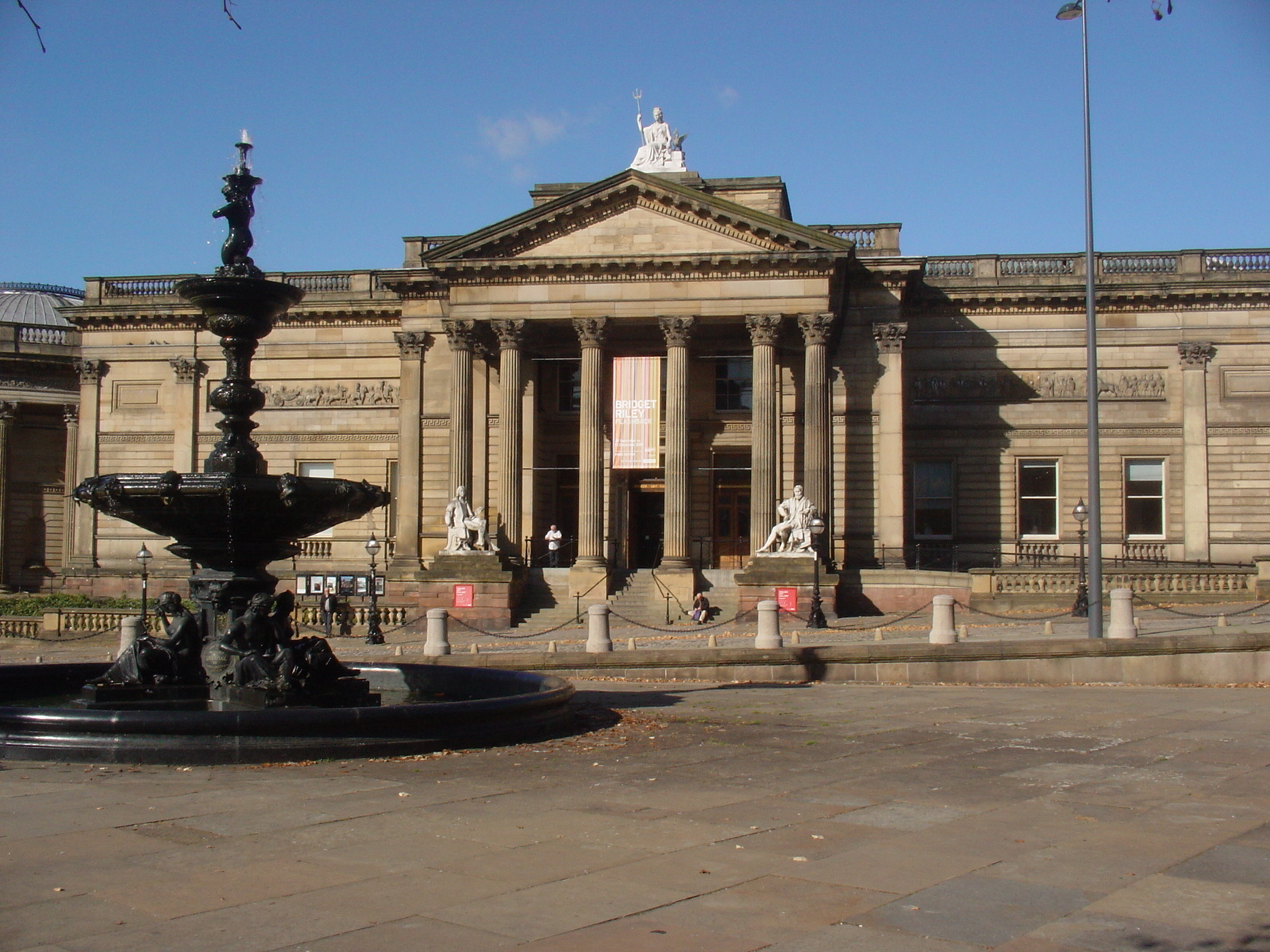
In May 1911 the decision was made to form a new exhibiting society from the ranks of Fitzroy Street and so the Camden Town Group was founded. The end of that year saw Bevan moving away from the portrayal of the cab yards to the London horse sales at Tattersalls, Aldridges, the Barbican, and Wards (see Horse Sale at the Barbican, Tate Gallery and Under the Hammer, Walker Art Gallery, Liverpool)
 .
.The Camden Town Group was short-lived. After three financially unsuccessful exhibitions Arthur Clifton, who ran the Carfax Gallery, declined to hold any more. However he still continued to back individual members and Bevan had his third one-man show there in 1913.
In 1913, The Cabyard, Night, the only painting by Bevan acquired for a public collection during his lifetime, was bought by the Contemporary Art Society on Frank Rutter's recommendation that they should obtain it for the nation before a more discerning collector bought it.

William Marchant, of the Goupil Gallery, offered his larger premises on condition that the Group was expanded and that it changed its name.This resulted in the formation of the London Group in the autumn of 1913. Harold Gilman was elected president, J.B. Manson secretary and Bevan treasurer.
From April 1914 until September 1915 Bevan rented a studio in Cumberland Market,
 London’s hay and straw market in Camden Town. It was here that the Cumberland Market Group consisting of Bevan, Gilman, Charles Ginner and John Nash held Saturday afternoon ‘at homes’. The four exhibited at the Goupil Gallery in May 1915 and were later joined by Edward McKnight Kauffer and C.R.W. Nevinson.
Mare and Foal, 1917.
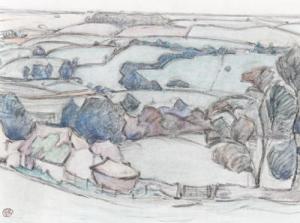
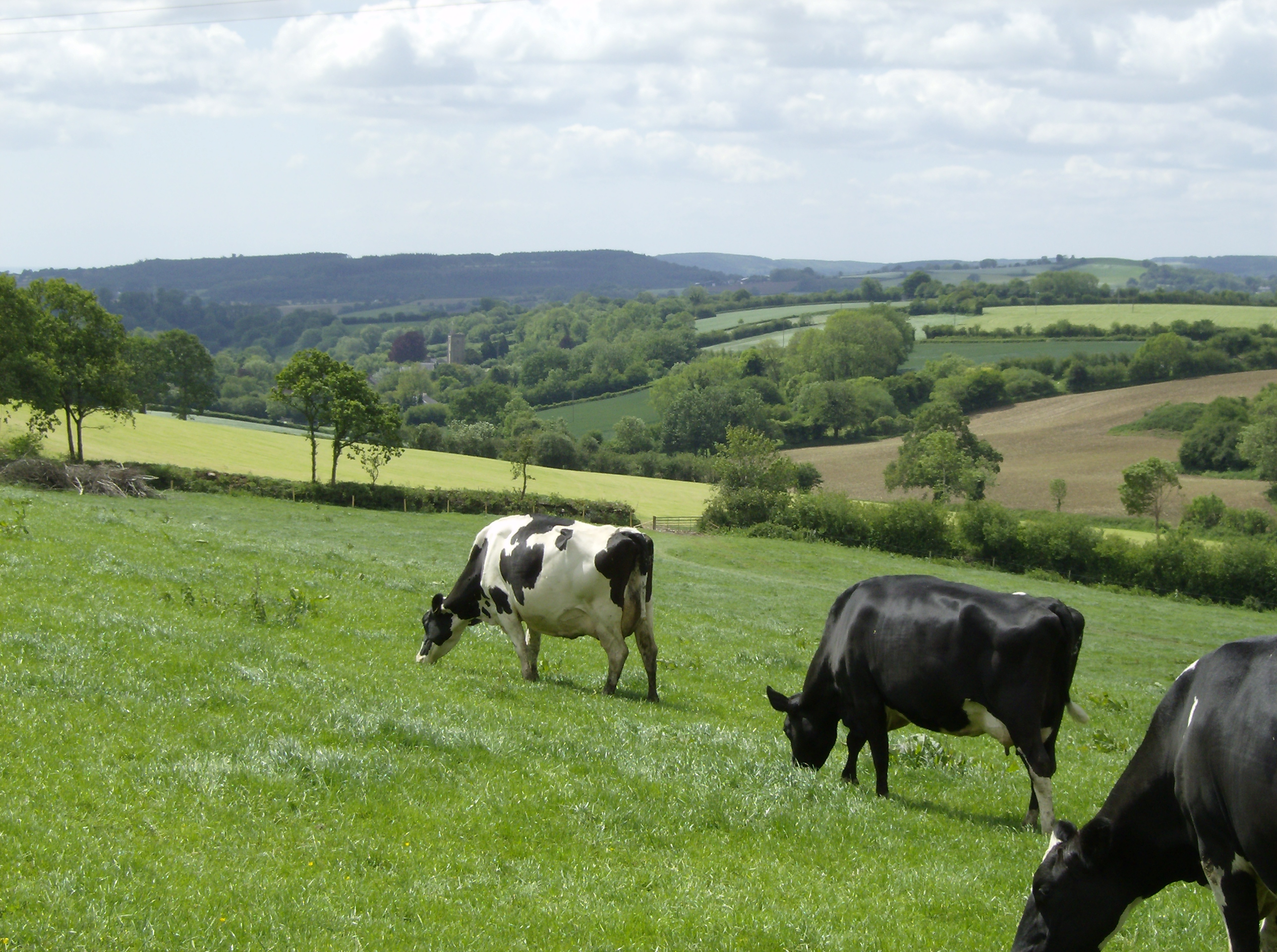 on the Devon-Somerset border as a guest of landowner and amateur artist Harold Harrison. Until the end of his life Bevan continued to paint in the Bolham valley
 and nearby Luppitt his angular style sitting well with the strong patterning of the landscape.
His London street scenes, which were largely in the area of St John's Wood
 and Belsize Park,
 were generally more favourably reviewed than his landscapes.
In 1922 he was elected to the New English Art Club.
Bevan died on 8 July 1925, following an operation for stomach cancer.

The Horse Mart (Barbican No. 2), 1921. Lithograph.
 that year the artist's son published his memoir and organised a series of exhibitions.
Bevan’s modesty and reticence and his “almost complete inability to put himself forward”ensured that most of his works were unsold and a considerable number were left to his wife on his death. Stanislawa Bevan left her estate equally between her son R.A. Bevan and daughter Mrs Charles Baty.In 1961 they presented the Ashmolean Museum, Oxford
 with The Bevan Gift in honour of their parents’ work.
No comments:
Post a Comment