Wednesday, 22 June 2016

cornish potato

  • 4 medium Potatoes
  • Milk
  • 4oz Plain Flour
  • 2oz Margarine
  • Salt
  • White Pepper

Method

Peel the potatoes, chop into 1" cubes, and boil until soft in lightly salted water. Drain potatoes, mash with a little milk and season with salt and white pepper. Leave to cool.
In a bowl, rub the margarine into the flour, until it looks like breadcrumbs. Add the (cool) mashed potatoes, and mix well.
With floury hands, form the mixture into patty shapes the size of burgers, and fry in a little butter in a frying pan, turning halfway through. Delicious served with a little butter on top.
(These can be frozen easily after forming into patty shapes. Flash freeze on trays, then gather up into bags later. Easy to make a lot in advance and then just pull out whenever you want a fry up.)
(makes about 8)

Sunday, 19 June 2016

rodin and drawing

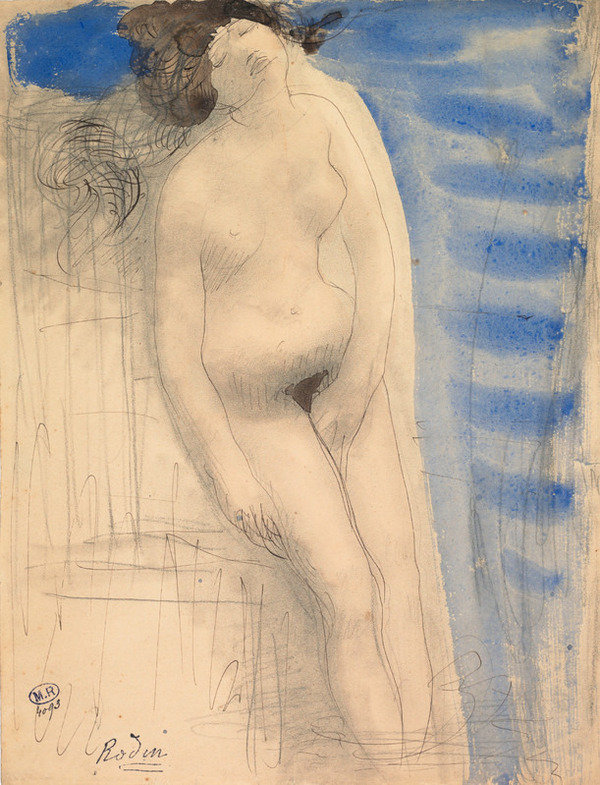
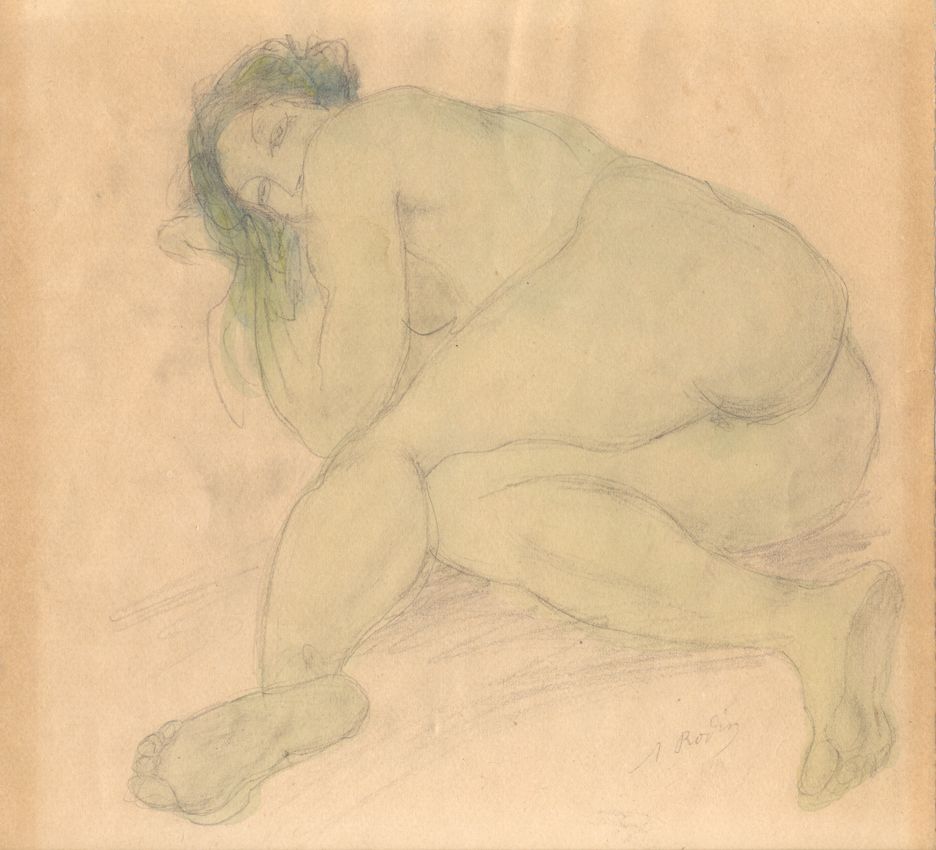
We know Rodin the sculptor, but do we know Rodin the creator of drawings? This exhibition spectacularly presents a collection of 300 drawings of his last thirty years. During the last part of his life, drawing was the artist’s predominant form of expression. 

At over 60, Rodin embarked upon a true career as a drawer. He had always drawn, but the drawings that date from after 1890 can be considered the last manifestation of his genius. Drawing every day from a live model, his passion resulted in a collection of nearly 7,000 pages, brought together almost in its entirety at the Musée Rodin. Starting in 1903, the museum organized several exhibitions devoted exclusively to the body of his works in drawing. The Musée Rodin’s ambition is to reconnect with the richness and the breadth of these exhibitions, allowing the public to discover this little-known aspect of his talent.

Through the reconstitution of the major identifiable series (little drawings in ink and watercolor from the years 1890-1895; the Psyches; the Women in Peignoir; the Cambodian Dancers; the shaped and shaded drawings of around 1910; the last drawings, splashed with color, to name just a few), certain themes and characteristics of the artist’s drawings are explored, such as the practice of drawing and the importance of the form that is changed, corrected, erased, cut up, folded in two; the mastery of the continuous and synthetic line; the relationship of body to space; and, finally, the femme fatal or the sexual bodies.

The proposed sequence of the exhibition will end with Rodin’s final drawings, which demonstrate the extraordinary tension the artist introduced between the naturalism of a drawing, capturing a gesture, a movement in all its immediacy, and the increasing independence of line and color. Rodin’s freedom in drawing contributed to opening an immense space for the artists of the 20th century. The true mission of the exhibition is to make the viewer sense this liberty.

On the occasion of this exhibition, the museum will also present a selection of works drawn by the artist Paul-Armand Gette, whose set of themes surrounding the feminine body echo Rodin’s drawings, on the first floor of the Hôtel Biron.

General Commissioner of the exhibition: Dominique Viéville, General Curator of Cultural Heritage, Director of the musée Rodin
Commissioner of the exhibition: Nadine Lehni, Chief Curator of Cultural Heritage of the Musée Rodin

Catalogue Rodin 300 dessins 1890-1917, joint publication with Editions Nicolas Chaudun, 256 pp., 39 euros


We know Rodin the sculptor, but do we know Rodin the creator of drawings? This exhibition spectacularly presents a collection of 300 drawings of his last thirty years. During the last part of his life, drawing was the artist’s predominant form of expression.

At over 60, Rodin embarked upon a true career as a drawer. He had always drawn, but the drawings that date from after 1890 can be considered the last manifestation of his genius. Drawing every day from a live model, his passion resulted in a collection of nearly 7,000 pages, brought together almost in its entirety at the Musée Rodin. Starting in 1903, the museum organized several exhibitions devoted exclusively to the body of his works in drawing. The Musée Rodin’s ambition is to reconnect with the richness and the breadth of these exhibitions, allowing the public to discover this little-known aspect of his talent.

Through the reconstitution of the major identifiable series (little drawings in ink and watercolor from the years 1890-1895; the Psyches; the Women in Peignoir; the Cambodian Dancers; the shaped and shaded drawings of around 1910; the last drawings, splashed with color, to name just a few), certain themes and characteristics of the artist’s drawings are explored, such as the practice of drawing and the importance of the form that is changed, corrected, erased, cut up, folded in two; the mastery of the continuous and synthetic line; the relationship of body to space; and, finally, the femme fatal or the sexual bodies.

The proposed sequence of the exhibition will end with Rodin’s final drawings, which demonstrate the extraordinary tension the artist introduced between the naturalism of a drawing, capturing a gesture, a movement in all its immediacy, and the increasing independence of line and color. Rodin’s freedom in drawing contributed to opening an immense space for the artists of the 20th century. The true mission of the exhibition is to make the viewer sense this liberty.

On the occasion of this exhibition, the museum will also present a selection of works drawn by the artist Paul-Armand Gette, whose set of themes surrounding the feminine body echo Rodin’s drawings, on the first floor of the Hôtel Biron.


sky bar

  • What:
    Public Free Visit - Morning at Sky Garden
  • When:
    Friday 1st July at 11:00am
  • Attendees:
    • gary byrne
    • sergio bagaggiolo
  • Price:
    Free
  • Reference:
    210-141361-1

getting a suit done

This is approximate - you can always change your mind on the first fitting anyway.
Vents:
These are very important. The classic length of a vent is normally 5 inches, but anything up to 12 inches is acceptable. Also where you want your vents is equally important. A centre vent is just as good as side vents, it all depends on your personal taste.
Pockets:
On a jacket these can be straight, or point up or down at 45 degree angles. Most "mod suits" have ticket pockets and always on the right hand side.
Bottom of the jacket:
This can either be rounded or at right angles. Both look good, but right angles generally look better on a double breasted suit.
Style of the lapel:
Again, very important. most mods go for a slim lapel. Lapels normally finish at the point between your nipples. Although if you go for a 4 button suit the lapel may well be smaller.
Stitching:
On your suit, this can have the effect of making it look totally different. A hand stitched suit always looks that bit better, it looks like a lot more effort has been made in it's creation.
Lining and material:
These are always a personal thing, but most mods have at least one mohair suit in their wardrobe.
Cuffs:
For your suit, you have a choice of either butterfly, plain or double cuff. The butterfly cuff probably being the most elaborate, but with the plain cuff you can always ask for it to be made so it does actually "undo".
Buttons:
On a suit, buttons can be covered and the number on a suit varies with the style of suit. Most single breasted suits have a three button opening, whereas most double breasted suits willl be four button opening.
Half belt:
An optional extra with a suit. You can have it plain o
r with two buttons at either end.

Saturday, 18 June 2016

richmond to kingston walk


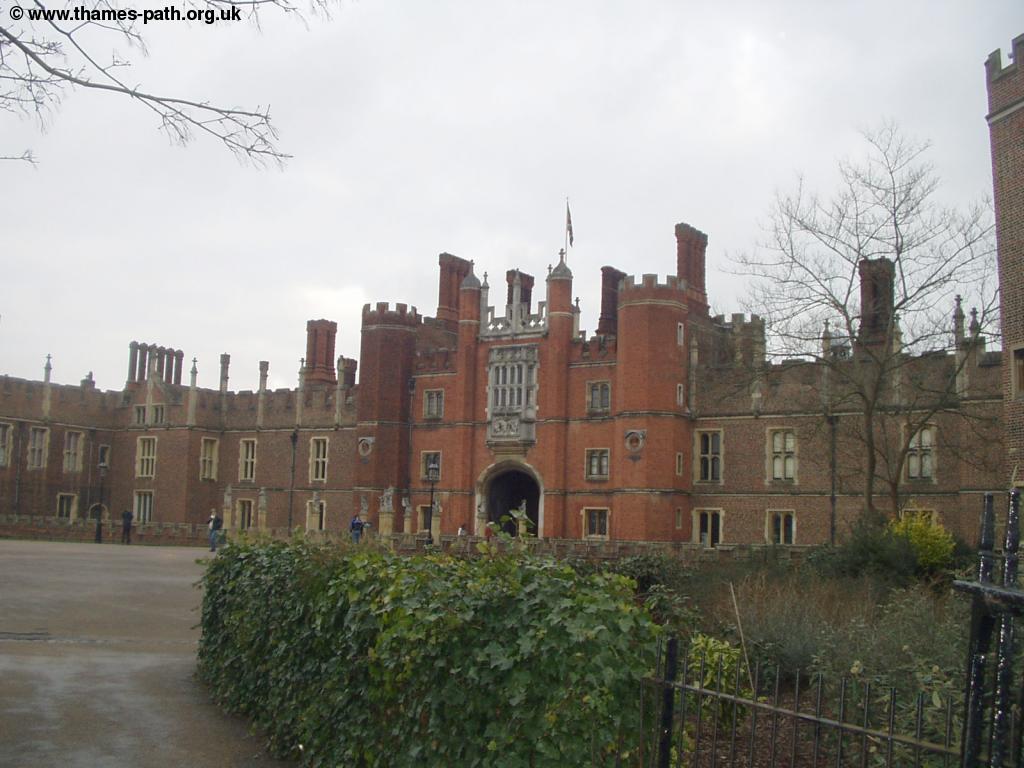
The interesting town of Richmond is the start point for this walk, where the Thames takes on a more rural feel. From Richmond you pass through Petersham Meadow, past Marble Hill House and Ham House, through quite rural settings to Teddington Lock and Weir, which is the point at which the Thames is no longer tidal. From Teddington you continue into the town of Kingston-upon-Thames, which has an attractive market place, then on along the edge of Hampton Court Park to the historic Hampton Court Palace.
Getting to the Start
Richmond Station has excellent transport links and the Thames Path is signed from the station. South West Trains run regular trains from Clapham Junction & London Waterloo to Richmond. Trains also run regularly (generally at least twice per hour) to Richmond from Twickenham, Staines, Windsor, Bracknell, Wokingham and Reading.
The London Underground District Line also runs to Richmond (the last station on the line), with frequent trains from central London, east London and Upminster in Essex. Richmond is in London Travelcard zone 4.
Finally, the Silverlink Trains North London Line ends at Richmond and runs from Stratford and North Woolwich in East London, across North and West London to Richmond, with trains running every 15 minutes from Richmond (every 30 minutes on Sundays).
Regular bus services operate from many parts of London and Surrey to Richmond.
The Walk
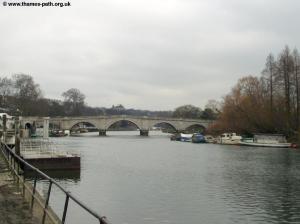
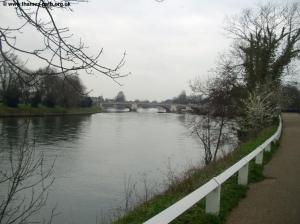
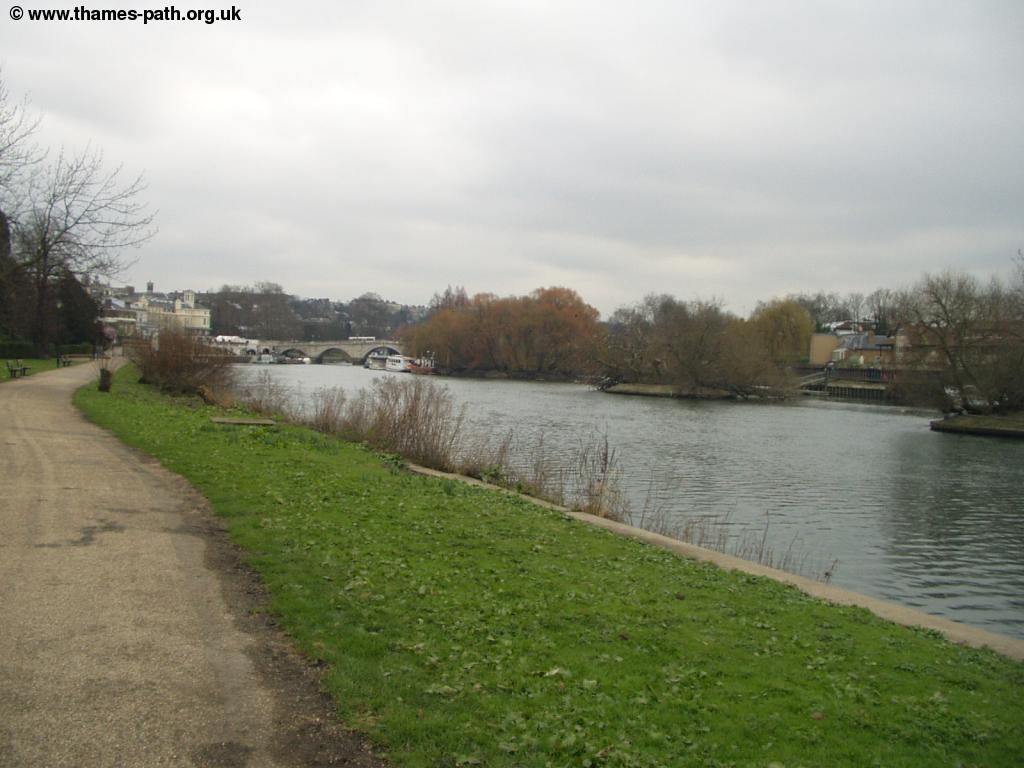
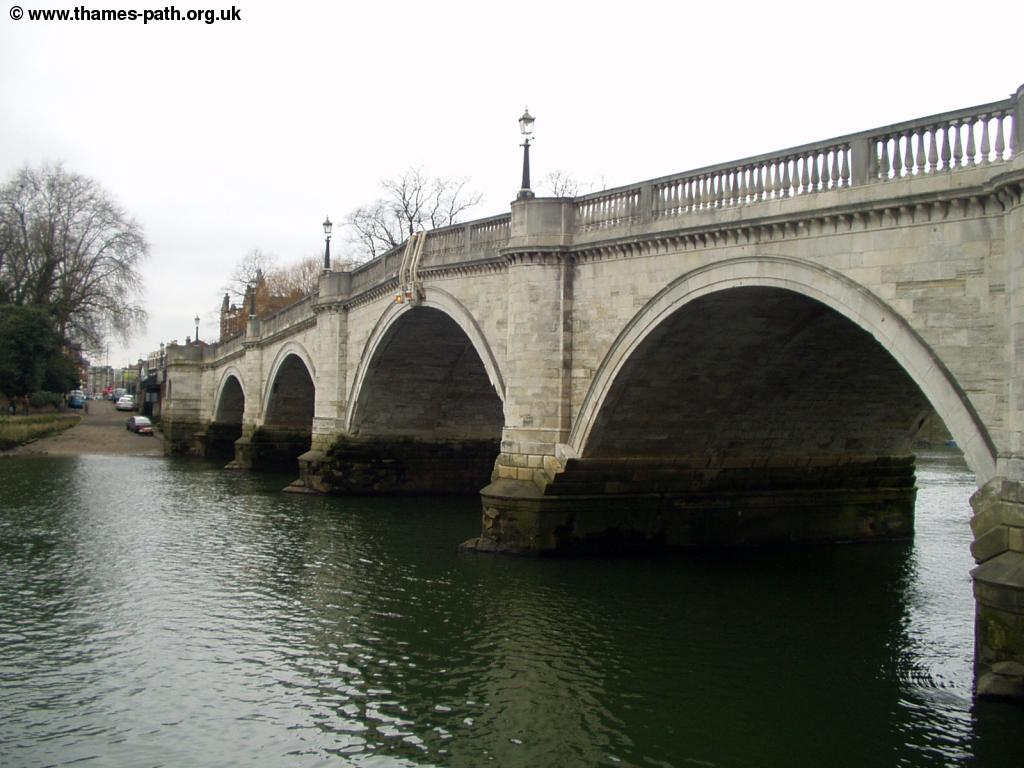
To return to the Thames Path near Twickenham Bridge from Richmond station exit the station down the road to The Square. Here head into Duke Street onto Richmond Green. Walk round or across the Green to the opposite corner, and head down Old Palace Lane, which brings you back to the river. Once on the river, turn left towards Richmond Bridge. This part of the path is already feeling more rural, with large houses on the left all along this stretch of the Thames.
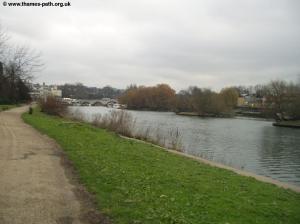
View towards RichmondRichmond Bridge
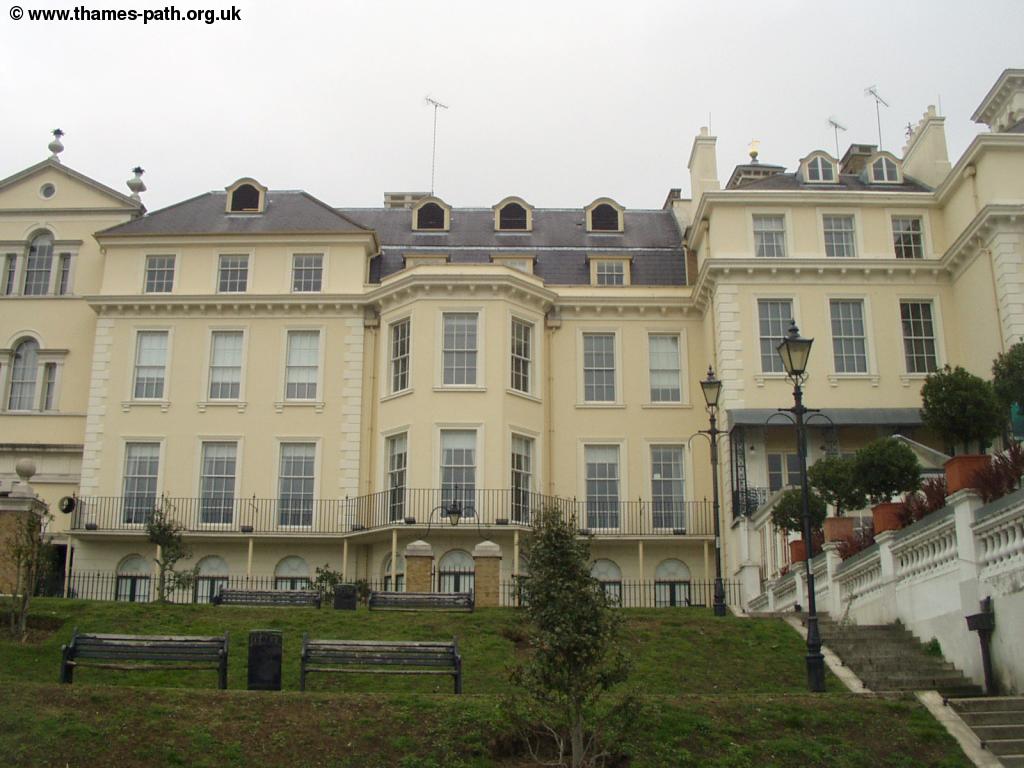
Houses at Richmond
Large houses by the river in Richmond
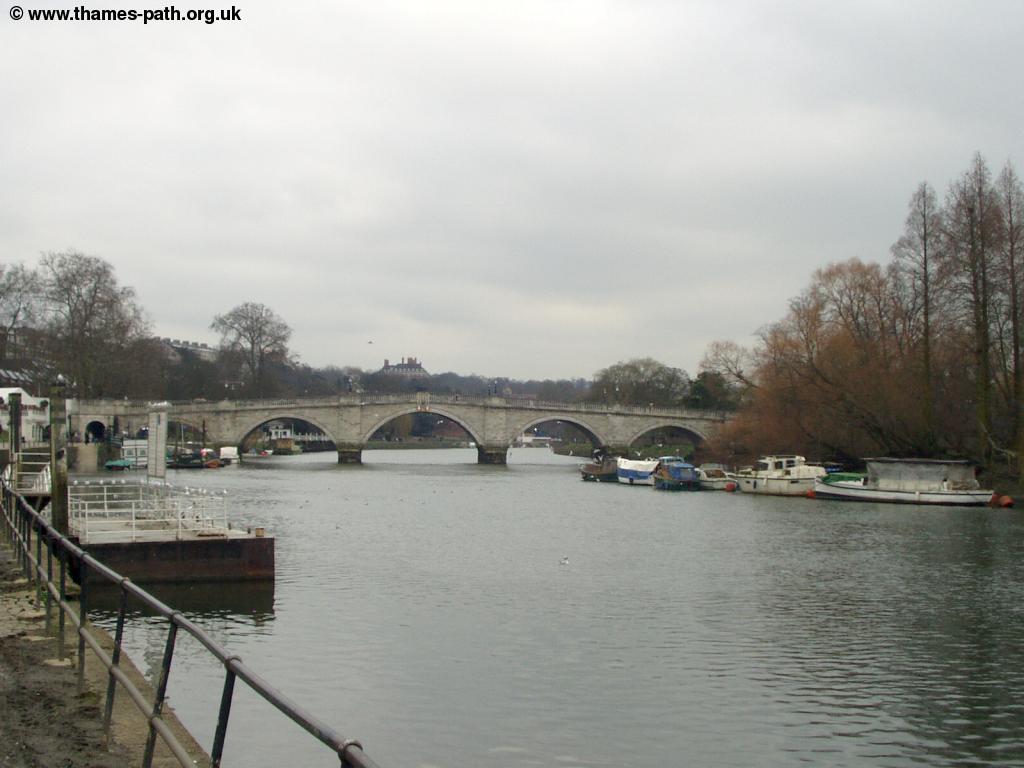
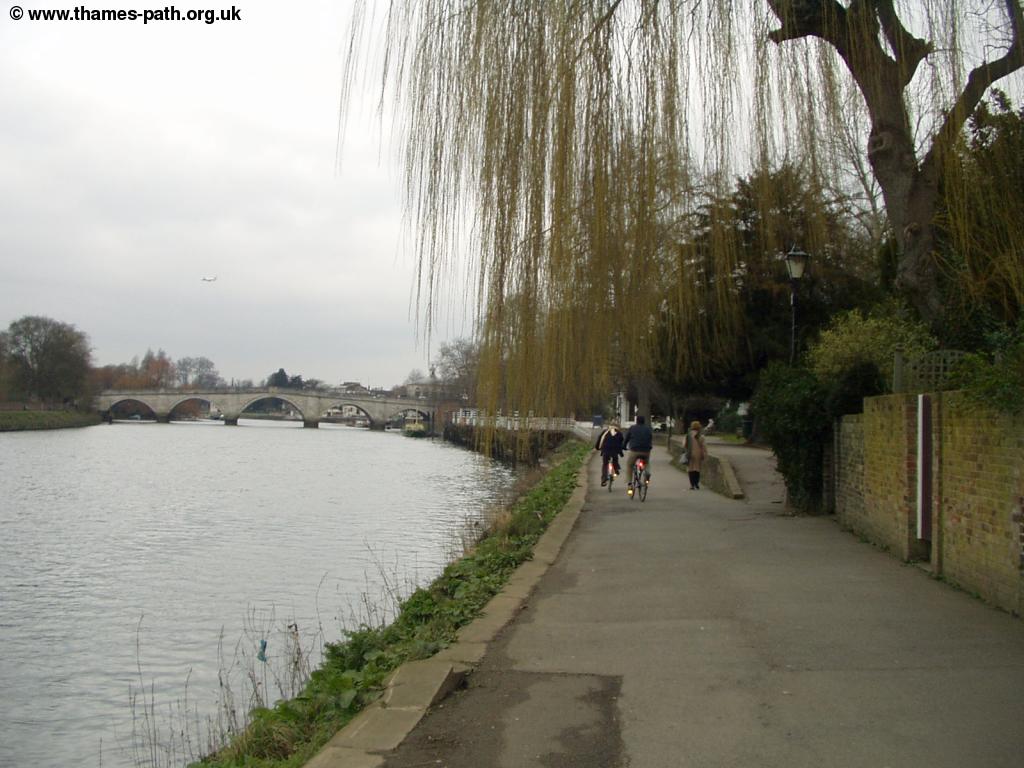
Continue under Richmond Bridge, where the path passes some more large houses on the left.
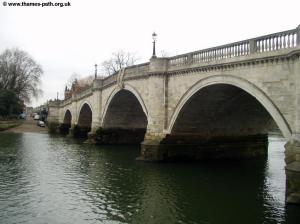
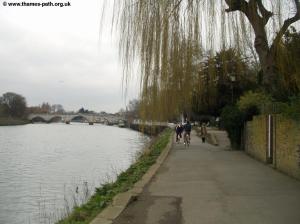
Richmond BridgeThe Thames path looking back to Richmond
Richmond BridgeThe Thames Path looking back to Richmond
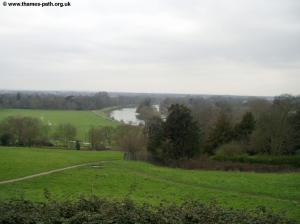
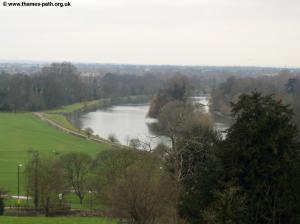
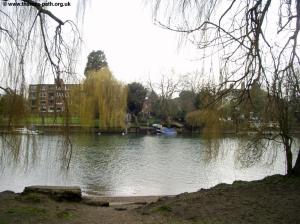
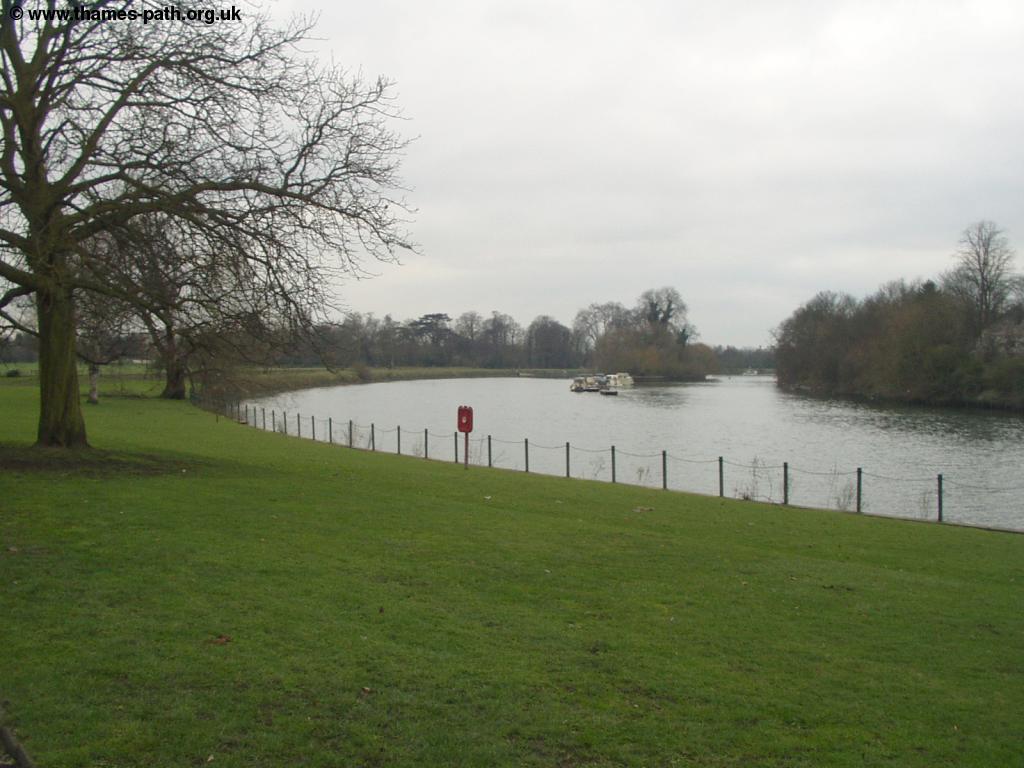
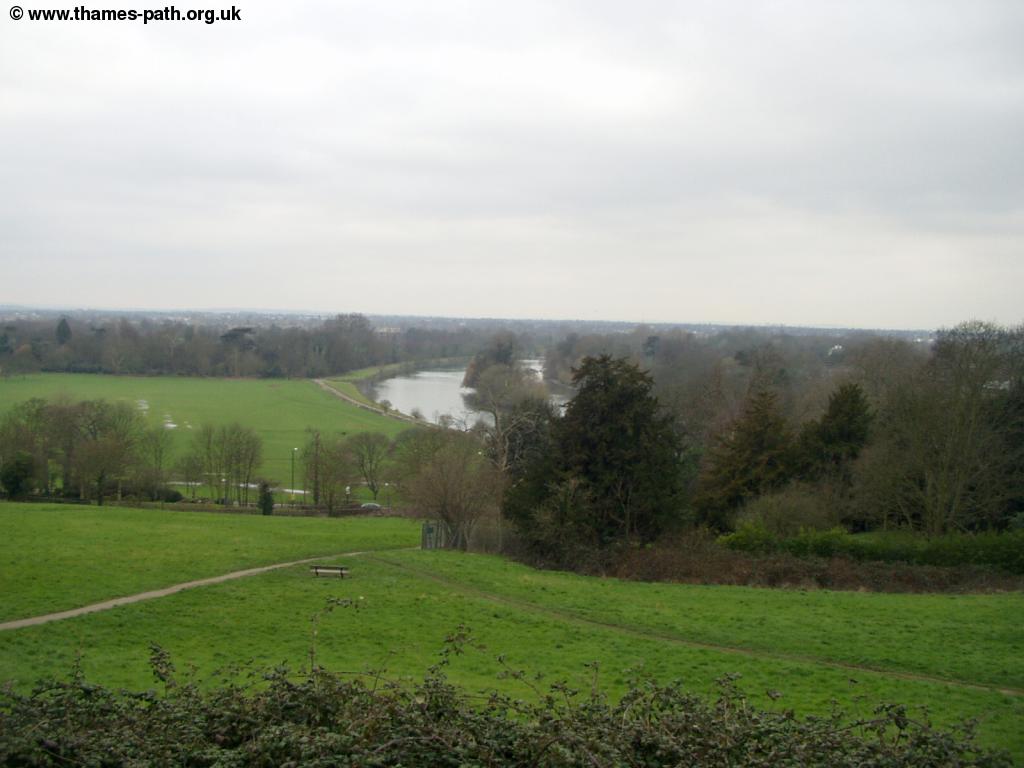
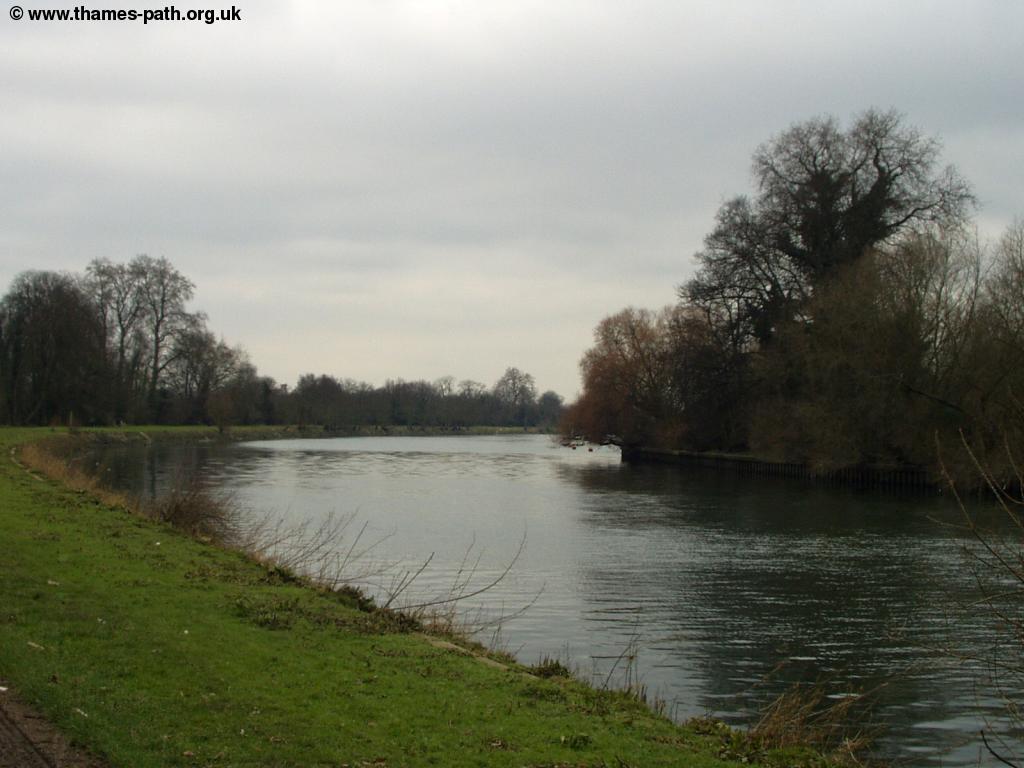
Soon the houses on the left end and you come to Petersham Meadows - the path ahead now looks very rural, with trees lining both banks and covering the small island in the middle. The path heads back from the Thames slightly here and when you get to the toilet, there are steps up to the main road. I climbed Richmond Hill to the left (the footpath begins just across the road at the pedestrian crossing), where there are superb views of the Thames below.
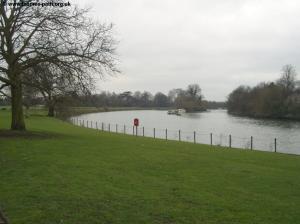
The Thames at Petersham MeadowsThe Thames from Richmond Hill
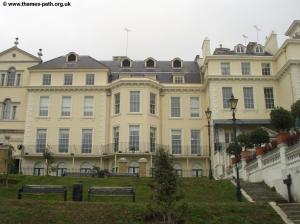
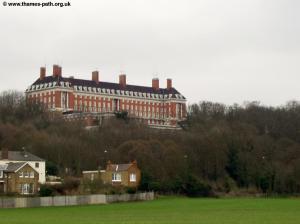
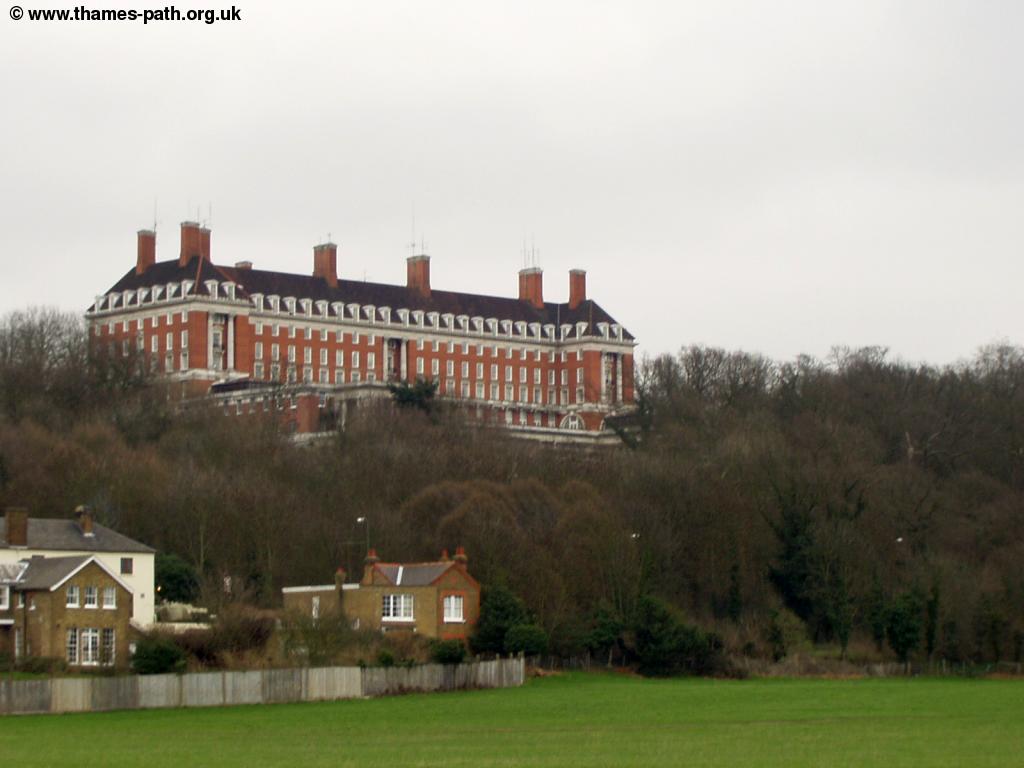
The Thames from Richmond HillThe Royal Star and Garter Home
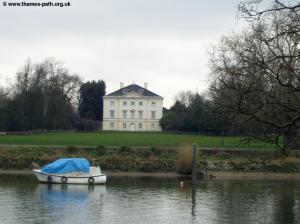
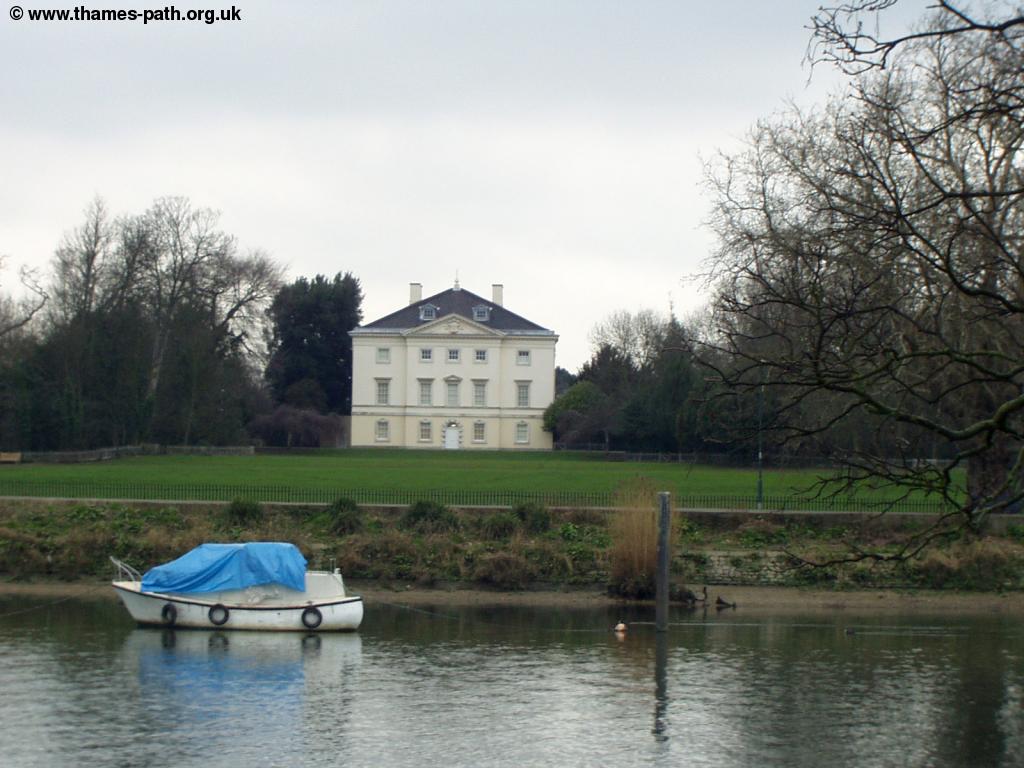
There is an attractive row of houses behind near the top of the hill, where there are a few information boards. Halfway up the hill you'll find The Petersham Hotel, a luxury hotel and restaurant, and the large building near the top of the hill is The Royal Star and Garter, a home for disabled Ex-Service men and women. Returning to the river the path takes on a rural character, with plenty of open space on either side. Soon you pass Marble Hill House across the river, set within Marble Hill Park. The house is now in the care of English Heritage and is open to the public during the summer. Shortly after passing Marble Hill House you then come to Ham House on the south side of the river. This house is now in the care of The National Trust and is open to the public during the summer, however the garden is open all year round, but not everyday.
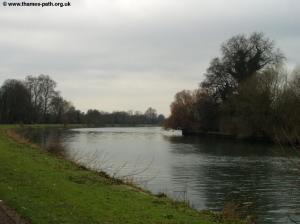
The Thames at Petersham MeadowsMarble Hill House
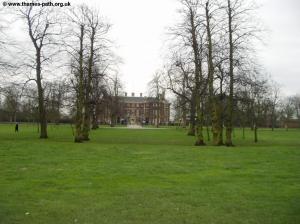
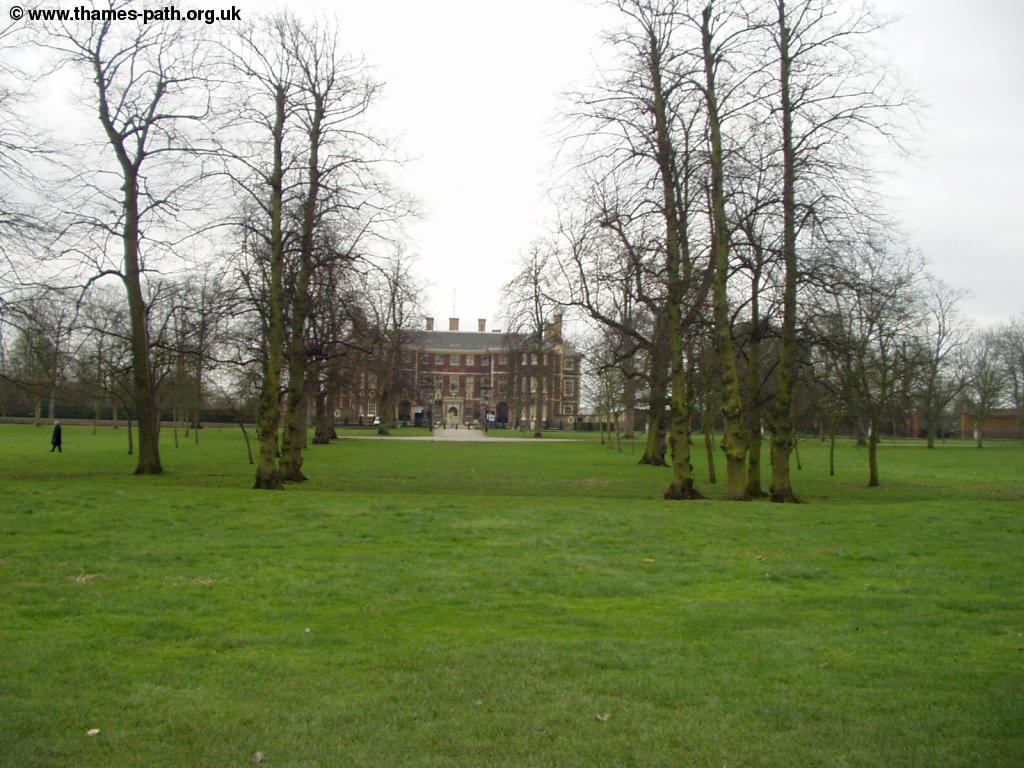
Ham House
Ham House
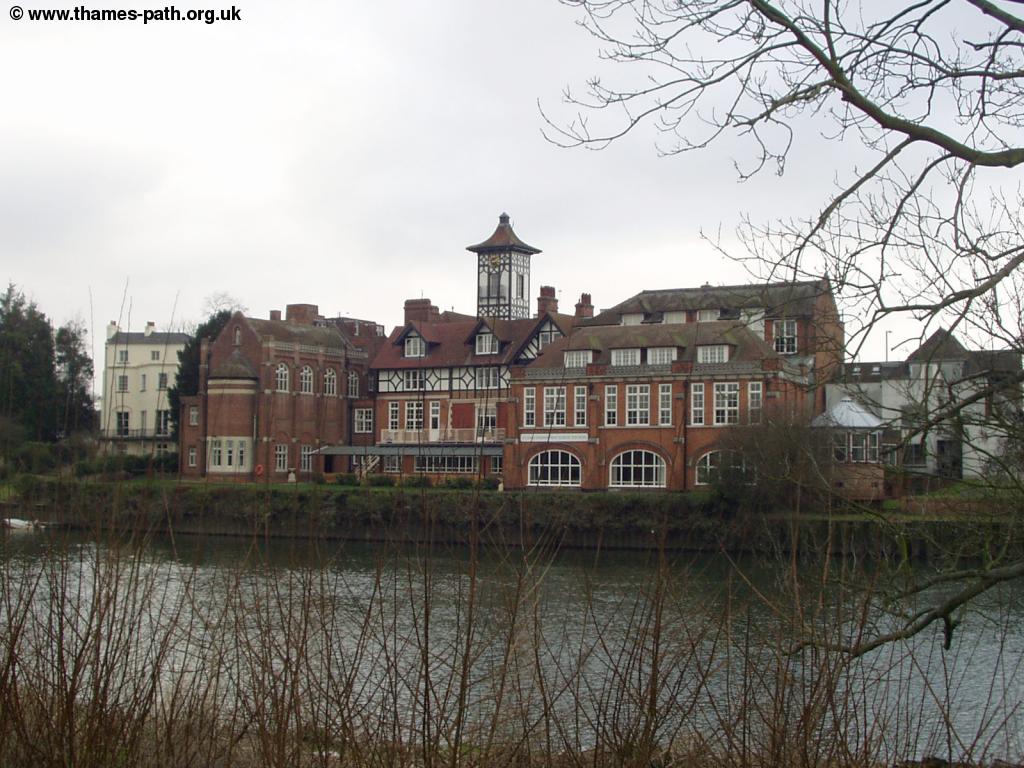
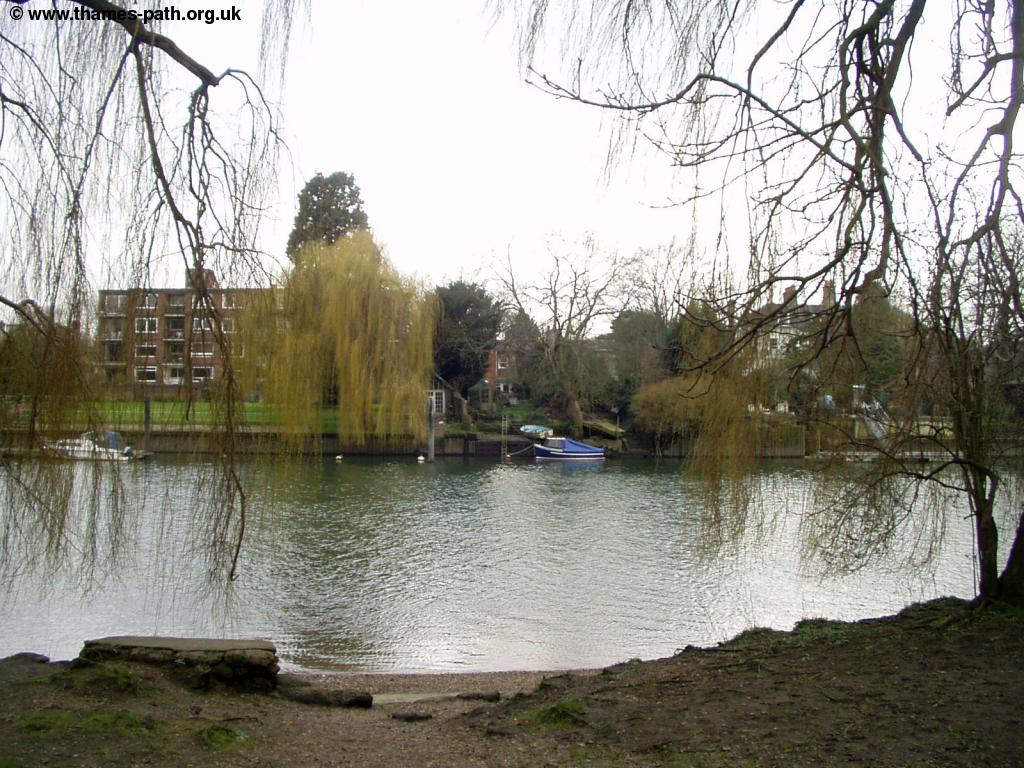
Soon you come to a car park on the left, then pass Eel Pie Island, which as well as being used as by a Yacht Club is now mostly residential, with around 50 houses built on it, connected by a footbridge, connecting it to the north side of the river at Twickenham. Once round the island you soon see the distinctive building of St James Independent School for Boys across the river. The Thames is peaceful here, with open land on the "South" side (actually East here) and the houses of Strawberry Hill across the river.
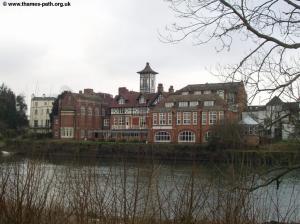
St James Independant School for BoysThe Thames looking over to Strawberry Hill
St James Independent School for BoysThe Thames, looking to Strawberry Hill
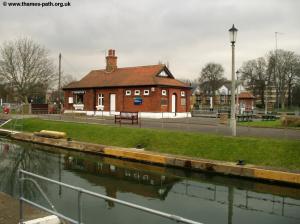
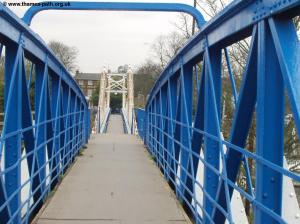
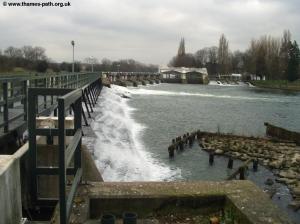
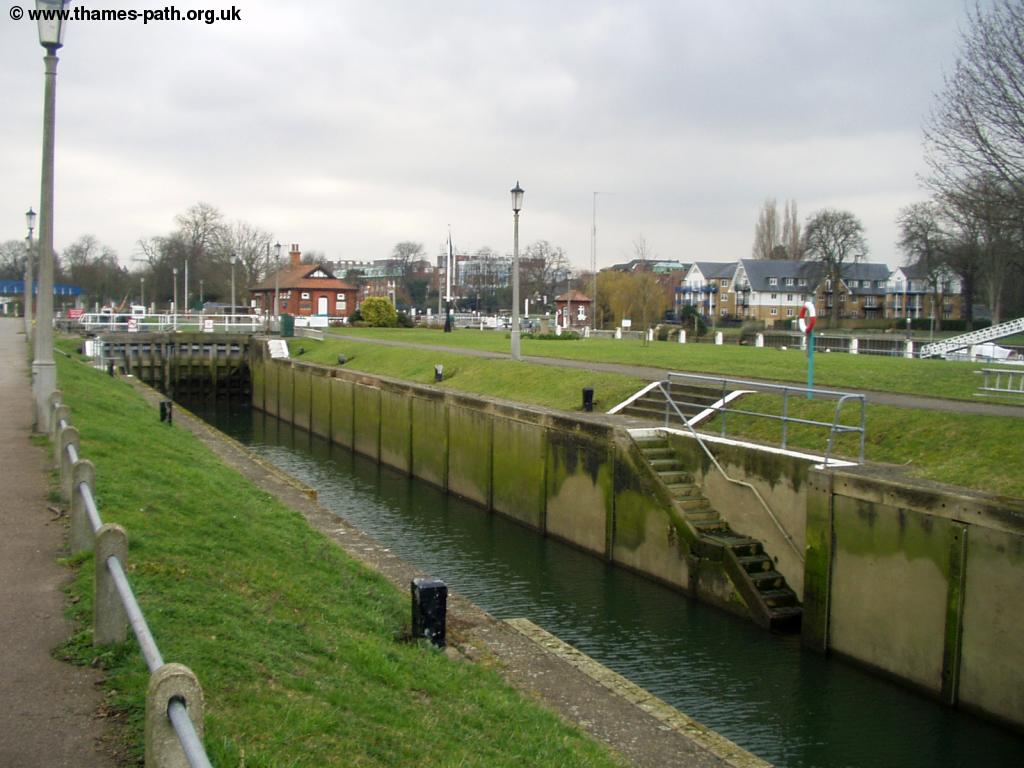
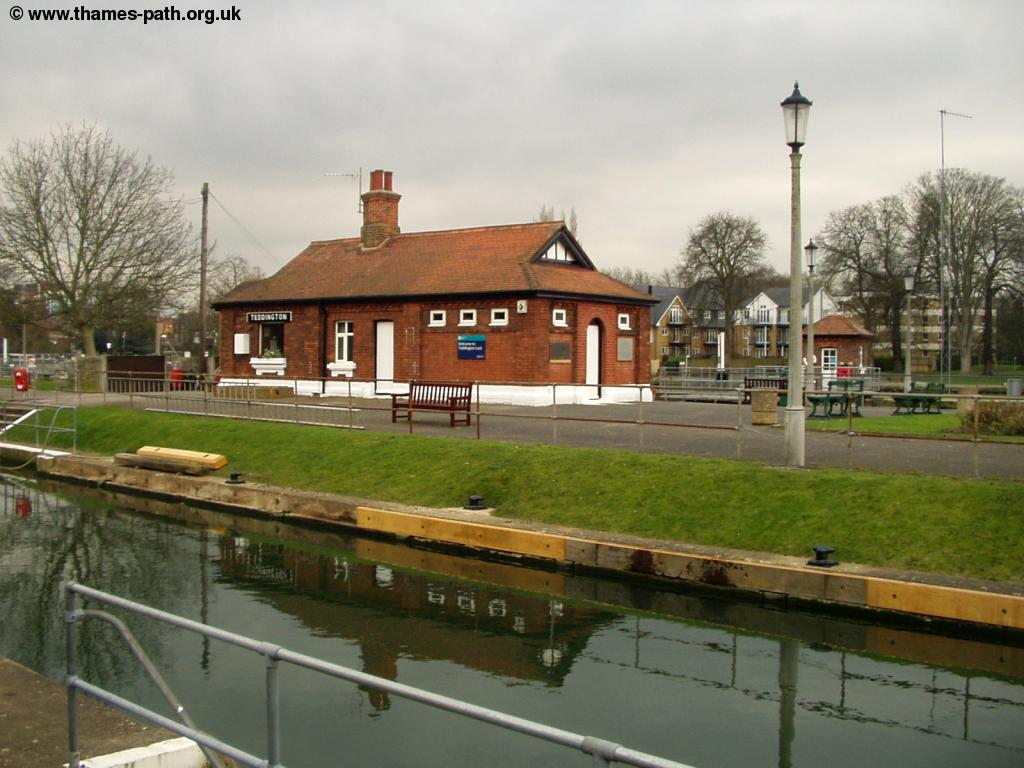
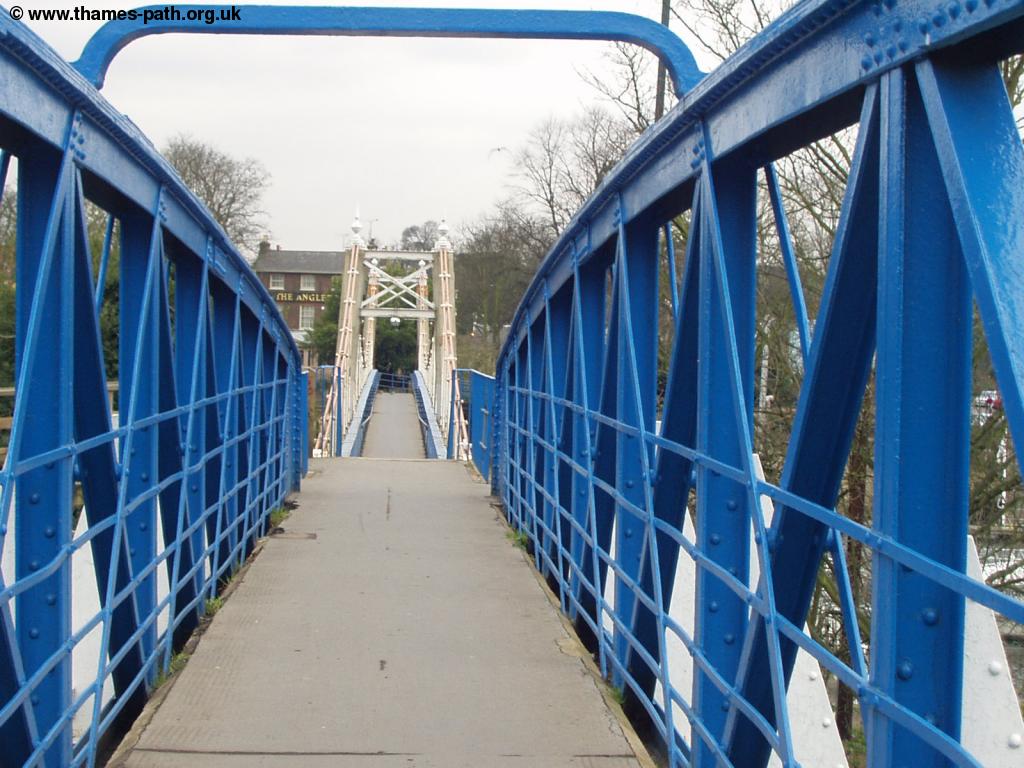
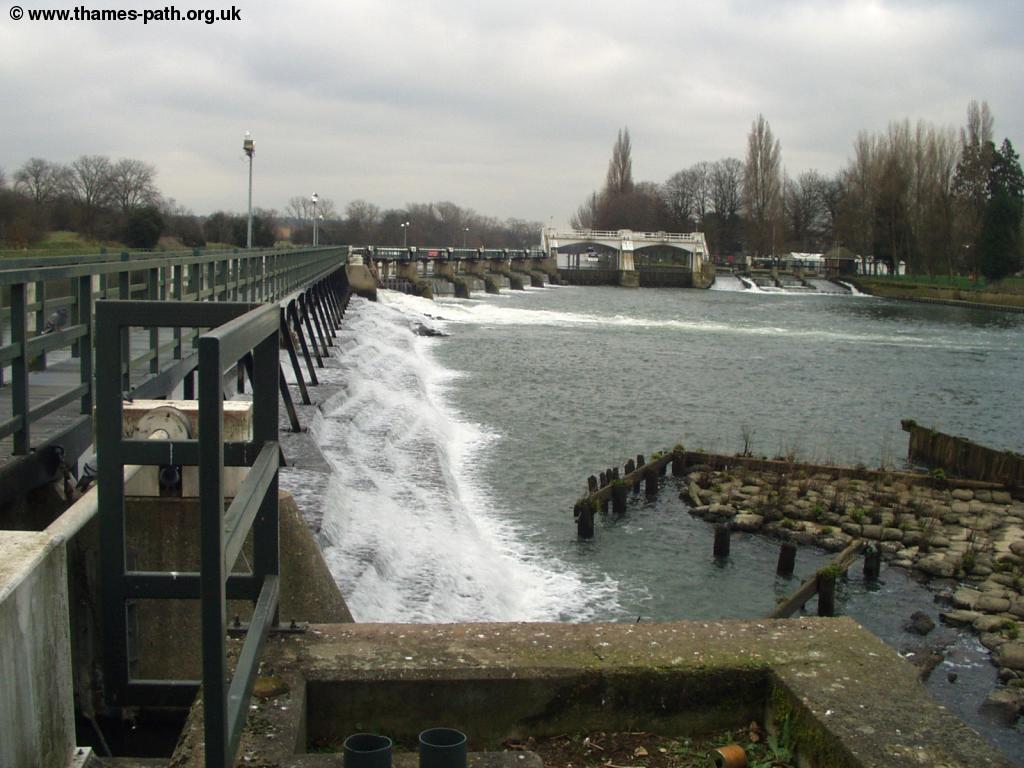
Soon the path climbs to cross the inlet to the Thames Young Mariners Base, a popular water sports centre. After walking through the edge of some woodland you soon come to Teddington Lock and Weir, the tidal limit of the Thames. There is also a weir here, over which around 178 million gallons of water per day flow. The river is still navigable by passing through the lock, which still has the attractive lock-keepers cottages.
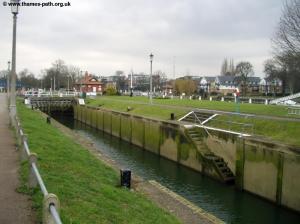
Teddington LockTeddington Lock
Double bridges at Teddington LockTeddington Weir
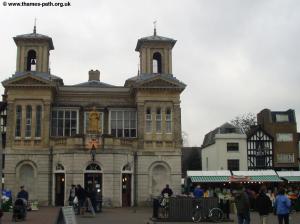
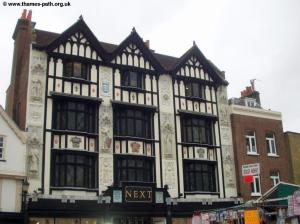
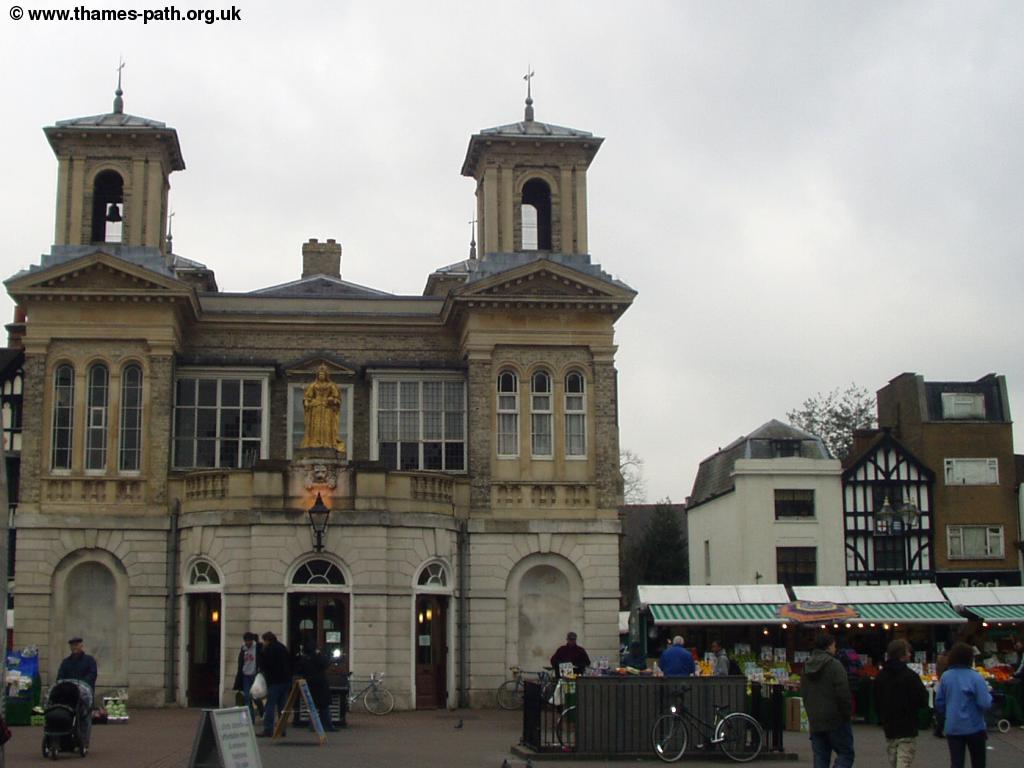
Beyond the Lock the river soon becomes more peaceful again, continuing through open land, but with houses getting gradually closer until you the narrow road (Lower Ham Road) for part of the distance towards Kingston. As you get closer to Kingston you pass The Boaters Inn in Canbury Gardens, a pleasant tree-lined park. This park continues all the way to Kingston Rail bridge into Thames Side, just before Kingston Road bridge, under the John Lewis Store. If you climb up onto the bridge you're at the top end of Clarence Street, the main shopping street in Kingston. Kingston is a large town with quite a bit of history, particularly the market square (which still serves it's original purpose), so it's worth spending a few minutes looking round. All the major high-street stores are here and there are several pubs along the river front too.
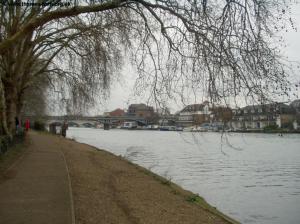
Approaching KingstonMarket House, Kingston
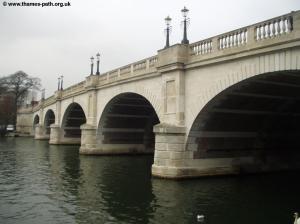
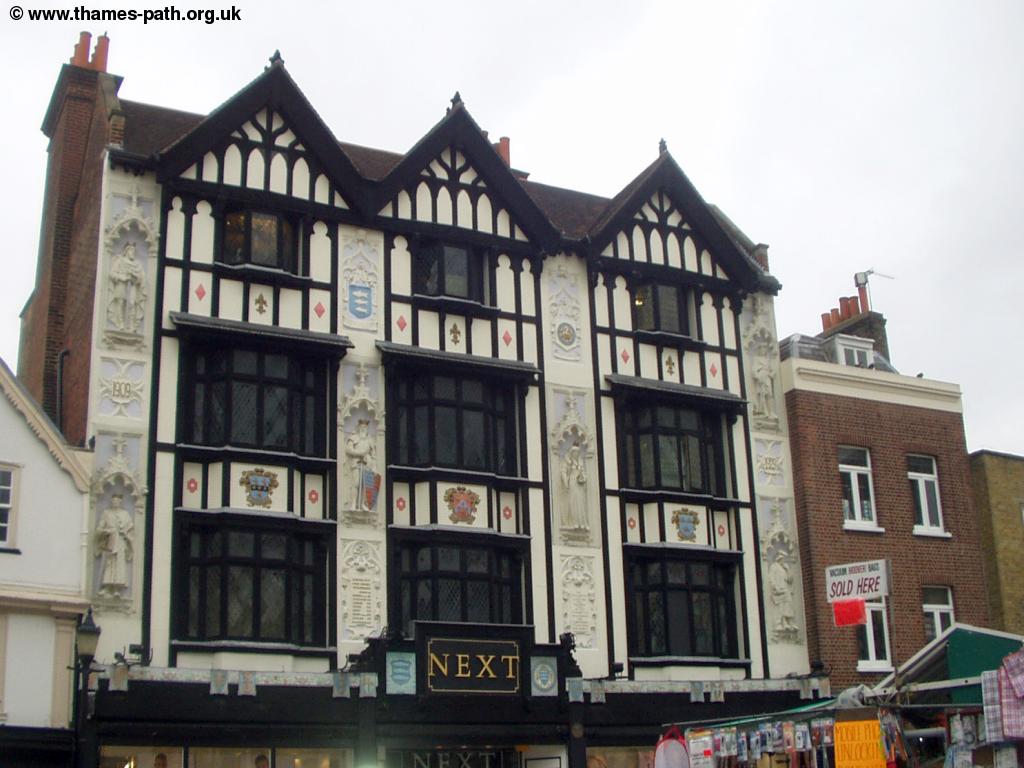
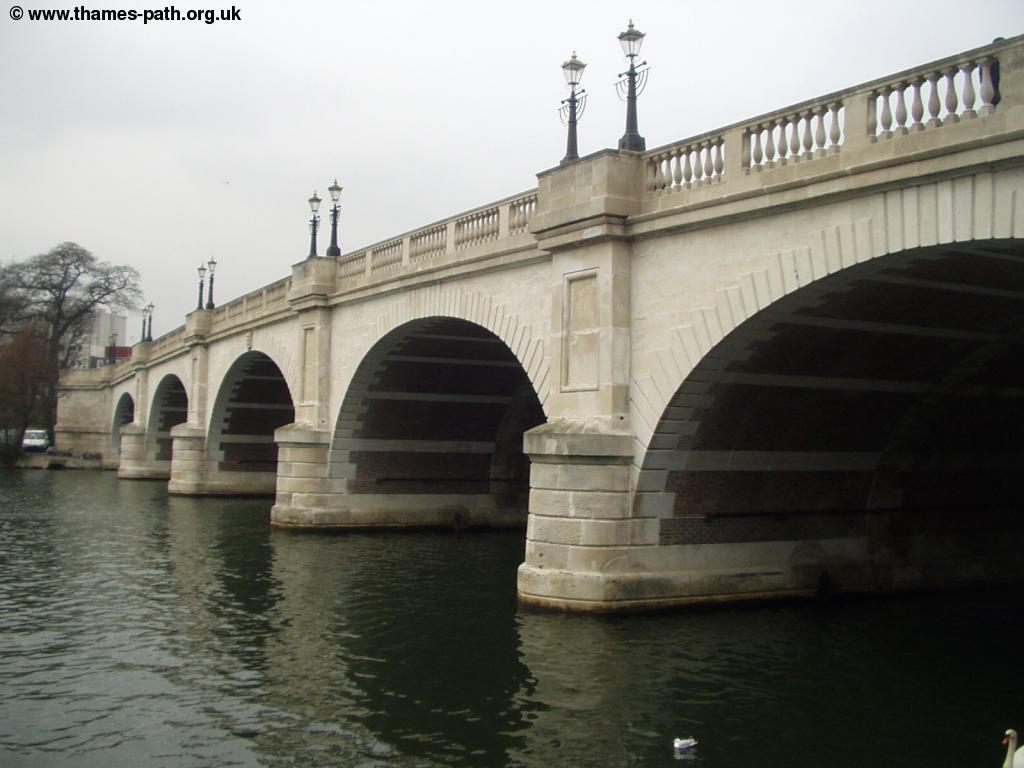
Next, KingstonKingston Bridge
NEXT KingstonKingston Bridge
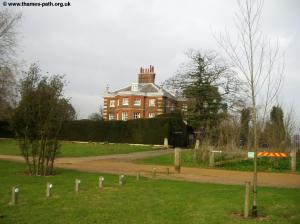
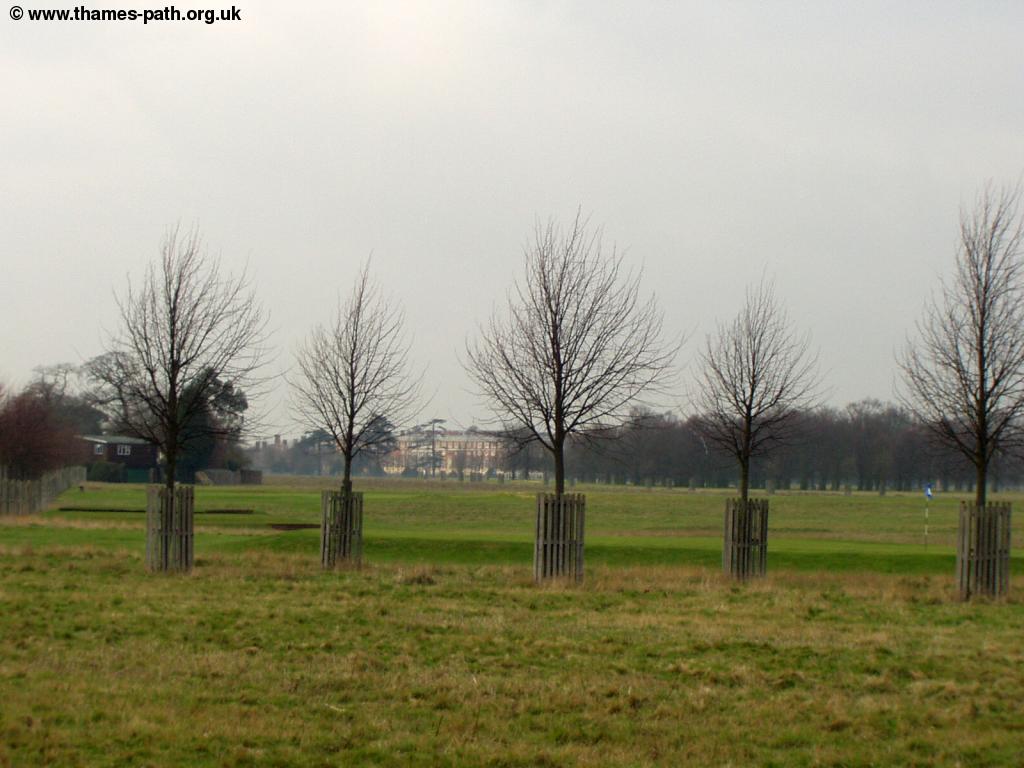
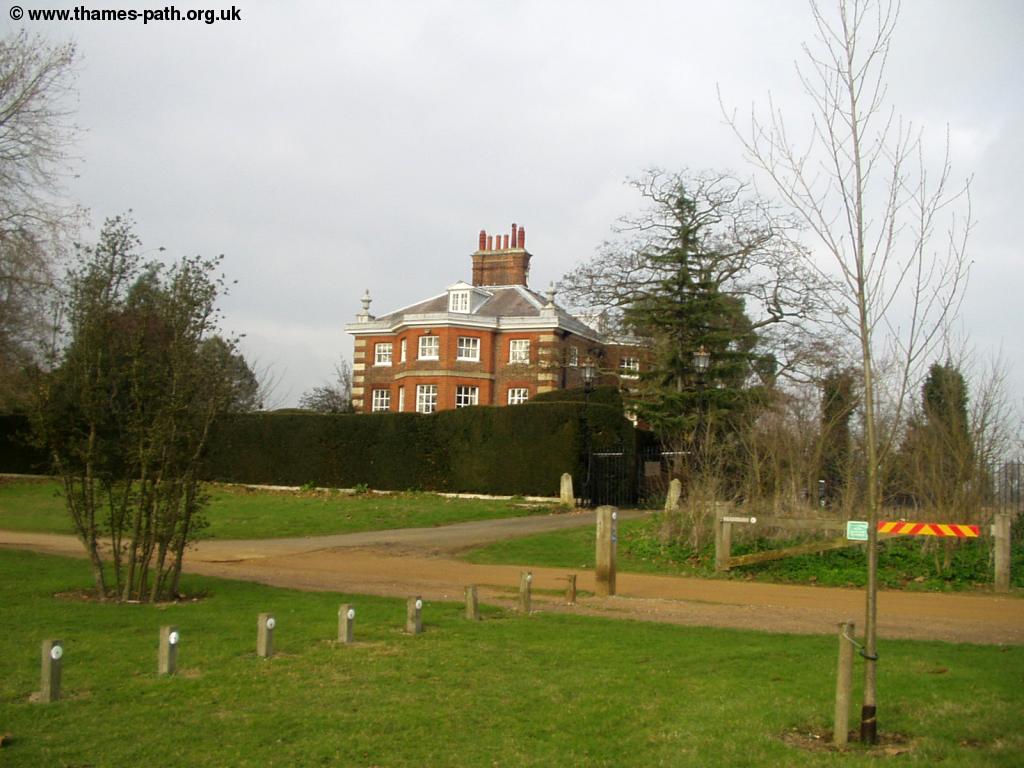
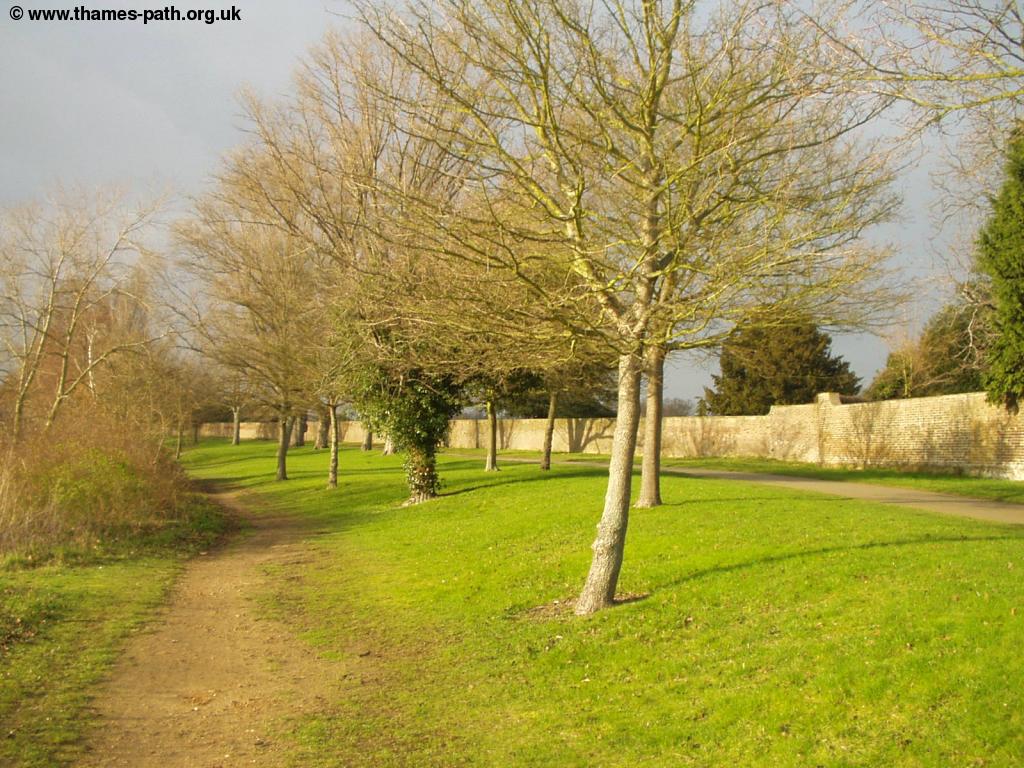
Kingston also marks the end of the Thames Path on both side of the river. From here on the Thames Path runs on one side only for most of the way to it's source. Although it looks as if the path continues along the South Side, you can only get as far as Surbiton before you have to join the road, so you need to cross the busy Kingston Bridge. The other side of Kingston Bridge is surprisingly rural, considering how close it is to the town centre. Head down the steps at the side of the bridge, which is in the outskirts of Hampton Wick. The path now becomes mostly gravel next to Hampton Court Park. It is pleasant and peaceful walking next to the park, and there are occasional gates providing access to the park and views of Hampton Court ahead. Soon you come to Raivens Ait, and island mostly occupied by a large Water sports Centre. Surprisingly part of Hampton Court Park is also used as a golf course. Soon you pass Thames Ditton Island on the left, where there are some exclusive houses. As you head towards Hampton Court you pass the pavilion in the edge of the grounds.
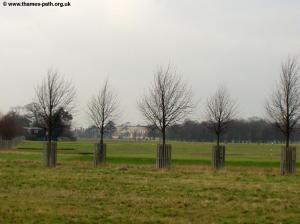
Hampton Court Park, with Hampton Court Palace aheadThe Pavilion
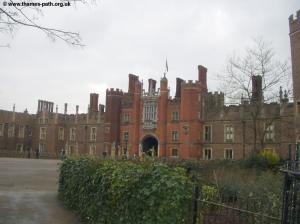
Soon the path pases the edge of Hampton Court Palace, but although the gardens are open to the public free of charge, the large gate which opens onto the river appears to be always locked shut. Nevertheless it is work exploring the gardens of the palace (which you can reach from the main entrance) which also includes the famous maze. The Palace itself is beautiful and was the home of Henry VIII. It is now open to the public daily and is a popular attraction. As you approach the bridge you will pass more boat landing stages - during the summer boats operate from Central London to Hampton Court, which takes more than 3 hours!
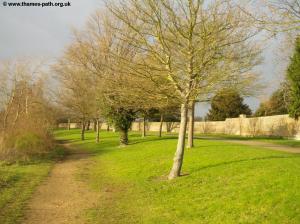
The Thames Path near Hampton CourtHampton Court Bridge
Hampton Court Palace
Getting Back
Just across Hampton Court Bridge you will find Hampton Court station, the end of a branch line from the main line station at Surbiton, continuing the more rural atmosphere of the Thames Path. It is served by trains, operated by South West Trains, every 30 minutes to Surbiton and on to London Waterloo. The trains call at all station to London Waterloo (with the exception of Queenstown Road), passing through Surbiton, Wimbledon, Clapham Junction and Vauxhall and taking a little over 30 minutes to get to London. Connections are available to Woking, Basingstoke and Guildford at Surbiton. Note however that the service is often reduced to a shuttle service to Surbiton when there is engineering works or other disruption. This service does not go to Richmond however, so if you need to return to Richmond by train, you need to change at New Malden.
Hampton Court also has regular bus services. Bus are very regular (generally at least every 10 minutes) to Kingston. There are also buses to a variety of other destinations including Sunbury, Ashford, Staines, Hanworth, Hounslow, Heston, Heathrow Airport, Feltham, New Malden, Cheam, Sutton, Croyden, Hampton, Teddington, Richmond and Kew.

EXTENDED INTERVIEW WITH PROFESSORBYRNEYARTY


WHAT WAS THE FIRST PAINTING OR ART THAT INSPIRED YOU 

LOOK and LEARN MAGAZINES . I liked Battle scenes because I used to play with soldiers  I was taken to the national by my dad but I wasnt very interested to be honest. I liked the paintings with battles in them and if they were paintings of fruit I was bored , my favourite painting was of a Napoleonic battle in Jersey , theres a black soldier in it defending his general , kind of strange but interesting. 
WHY ARE YOU CALLED PROFBYRNEYARTY
Its a play on the Moriarty character, everyone in my line of work has to have their nom de plum , is that what they call it? Banksy gave me the name because at the time I was working in an institute as a psychologist.I would walk into his studio and he would say "Ah professorbyrneyarty"
Me and my Dad ,We always walked through the rothko gallery and my Dad said always "Anyone could do that" .Later on I discovered Rothko more and I really admire him because he had guts . 
 There is a a multitude of meaningless bourgeois work that as soon as you see it you think=Mind Set snotty middle , we should have a major exhibition called something like THE MIND SET OF THE MIDDLE CLASS. Nearly all painting comes from them but I pride myself on being a working Class painter. I worked with the man who is now Banksy years ago and I would class his work now as working class. Great artist.That said is any art meaningless?

2) Your higher education is focused on the study of  Psychology. Do you feel this  occassionally feeds into your paintings ?
Absolutely, it does! All my art is about those places where we cannot go or dont know how to go. Im always a victim of the past and how I was brought up , I say a victim but that is not quite true some of it was ok , even good.

The ideas of any other artist are not present in my work  . I just paint who I am. Im also very interested in photography but photography that follows my ides on painting that being no rules.I like to think that what I do asks a question to the viewer, in my photography it is more obvious what question is being asked but as regards the paintings the question is maybe an enigma.
3) Where does your fascination for the  Abstract  movement come from ?
“NO RULES, NO CONSTRICTIONS”and no  ideas. I can go as far as saying, I create my own dimensions where I can enjoy following my own rules.And that is no rules .I never know what Im going to do , normally it is a feeling about a woman Ive just met, my best work comes from feelings like that.

4) Why have you chosen to dedicate your artistic career to exploring and representing the female universe ?
it's not a female one just a sexual one, if I liked men I'd paint men. I dont like men sexually so I rarely paint them .Sometimes Ill have a nude model but I wont really paint her just get her mood as I go along painting.For me a woman has to have soul about her even if she is not particularly interesting.

So most of your paintings are about sex?


The subject of a woman's sexuality is more or less something that plagues me , I honestly don't know why but obviously its something from the past, my childhood.All artists have to find a reason to paint and my reason is exploring women, its as simple as that . I would even say that Im just a writer who happens to use colour and photography instead of a pen . I do write though, poems and short stories.
a womans  sexuality is the most appropriate subject to express my contradictive personality . I love women but not in the usual way, for me they have pathos much more than men but that is because Im a man lol.
5) Which painting are you most proud of and why ?
If it moves its shit 
 I like that one. It was a painting I was fed up with so instead of throwing away I superimposed another image on top, it worked out and has a kind of strange feel to it now , sold to a Brazilian who loved it the moment he saw it, he didnt have much money but I knew he had to have it so we made a deal.
6) When are you at your most productive ?
Definitely when my emotions are at their most intense….after comes the need to let that emotion fly onto a canvas 

 Is there a lot of baggage attached to to being an artist ?
 The Art World’s management is a closed circle where often mayhem reigns free on a canvas….but not something interesting just total shite but thayt leaves the question what exactly is total shite , well I think it might be what I said earlier total shite is when the art is enthused with middle class preoccupation 


7) Tell us about your work space. What is the most unusual thing you keep in your studio ?
My studio is my front room , a kind of creative chaos where i find my order , after a while, becomes a painting
. I have homes in Gallipoli and in Milan and near Lecco . I also sculpt figures sometimes.But these are historical figures for my wargaming moments . Italy is also where I have a menswear operation going on and when Im there I hang out with my mates paolo and sergio who are totally uninterested in art so I tend to be discouraged from any art that is important .And there I cannot seem to paint very well so I save up for when Im back in London. Above MARI

8) Is there anything you dislike about the Art World? What is the hardest thing about anipulation and targeted commercial 
operation celebrate or dismiss an artist. They know little about art and artists only aboutselling 
Do you sell much?

Yes I sell a lot but I prefer to sell stuff to people who maybe 
dont have art in the forefront of their life but maybe see a piece by me and enthuse about it and I can see that they really want it. Sometimes Ill say what would you pay for that and they will give me a price and if I know they really like it its deal done.But  if someone only has a few quid Ill let them buy a painting or drawing by paying something every week 

Is being an artist difficult and also as regards economics?


 I was always discouraged by my family who never liked my work.When you are young and your closest adults deride your work then you are not exactly filled with confidence. I stopped painting for a long time but if it is in you it is in you.

 They insisted on representational art and that was really the reason why they never became real artists because they stuck themselves into a strict observational art that could never let fantasy in.Good artists in the extreme but in the end it was evening school nudes stuff like that if you get my meaning.

The hardest part about being a contemporary artist is just  remaining yourself and avoiding accomplishing requests of the market which are sometimes, purely led by trends.You should paint because you love it because although you need to sell you cannot base your life on that because you never know if you will sell.
Above Salentine shepherd

 I kn
 ow that all the people who buy from me feel they have something valuable and unique. 

What are you doing now?


Im painting a 25 foot mural on paper all in red about Che , at least the principle idea is the death of Che , sounds a bit 


teenagery maybe but of all the heroes we put up as real heroes he was maybe one of the few that deserves 


Do you ever paint solely that which you can see?

I find it pretty boring to be honest but sometimes I see a painting that is of that ilk and I think I wish I had done that.
Rare but sometimes I see something incredible and very often its by an unknown artist 


Do you like artists


Not really , most are boring with nothing to report, a lot of the stuff I see is crap to be honest because it comes from a mind thats boring


What is the average persons relationship with art?


rThey have  zero elationship, most, 
I  follow the Machiavellian idea that if one thinks the working class or lets say the masses have virtue then you are making a big mistake. That said it might be said that we have to educate those that dont have the opportunity to real education not the rubbish taught by stubblebums in schools who merely recite so called facts in many cases. It is not just the working class but also the middle classes , no idea about art.Thats maybe why we have an idiot class of middle class and working class. The middle class are merely working class with false accents and more money . Hope that does not sound too sure of itself but honestly although the people found at exhibitions are mainly middle class they have little idea of what they are looking at , lets say you ask them to name a really good modern artist , one working now, most cannot and that is why they know little about art .but I always get that feeling from the so called middle class, for me many are just an accent perpetuated through the years meaning nothing.


Tell us about your photography


Well I had a special lens made which allows me to get the kind of image I want . Its pretty technical but its really a great piece of equipment 


Do you still see banksy?


Yeh we have a drink now and then in Highbury and Islingfton,
 Cant tell you where but we are still good mates and I help him sometimes.Sometimes we go to football or we might go to Calais, he likes Calais

So you can't tell us who he is?


Well Ill only say this , Banksy is a cockney living part of the time in a house  down in the East end
 although he has lots of place where he lives, Ill say this , the idea that he lives in the west 
country is way off the mark.

Does he ever see your art?


Of course , he actually paints some of it


Can you give us a hint?

He is not Hirst, lots of people thinks hes hirst but how could someone like Hirst be banksy its like saying Monet was really Vincent