 The book describes the wandering boy's encounters with peasants engaged in all forms of sexual and social deviance such as incest, bestiality and rape, and in a huge amount of violence exciting a form of lust. The book title was drawn from an incident within its content. The boy, while in the company of a professional bird catcher, observes how the man took one of his captured birds and painted it several colors. Then he released the bird to fly in search of a flock of its kin, but when it came upon them, they saw it as an intruder and tore at the bird until it fell from the sky.
World War II has begun. A boy is sent to live in a village while his parents go into hiding from the Nazis. A woman who takes care of him, dies, leaving the boy to fend for himself. He is soon taken in by various individuals including a miller who gouges out his plowboy's eyes, and a man who sells birds. He walks to a village occupied by German soldiers. The local partisans turn him over to the Nazis. A soldier allows him to escape. The boy moves to another village, where he sees trains with Jews and Gypsies heading to concentration camps. He decides that fair-haired, blue-eyed people are God's favorites. He is handed over to a farmer in the nearby village. Soon, he becomes an altar boy. Angry peasants insist he is a vampire and throw him into a manure pit. He becomes mute. The priest sends him to yet another farmer. The boy watches the farmer's nineteen-year-old daughter have sex with a goat under the direction of her father. He leaves, when he sees her having sex with her brother.
In the next village, he is disgusted by sexual activities of a woman who takes care of him. Soviet deserters come to the village. They rape and murder the locals. The boy decides that God has not helped him because he is of the same kind as the black-haired Kalmuks. Soon, the Red Army arrives. The boy stays with them and decides to become a communist. He determines that revenge is a responsibility one must take. When the war ends, he is sent to an orphanage, where he pretends to be Russian and refuses to learn reading and writing. The boy's parents find him there and take him home. He resents having to give up his freedom, breaks another orphan's arm, and joins the people who roam the streets at night, gambling, drinking, and having sex. He moves in with an old ski instructor. While skiing, he falls, and is sent to a hospital. There, he feels an overwhelming desire to speak again. The novel ends as he regains his speech.
a movie that had the same culture or theme as the book was a Polish movie “Katyn” , it was really good, but it was extremely sad to see families being torn apart to be put in concentration camps and then shot… yes, they did show them being shot. This movie really portrays the theme of “The Painted Bird” illustrating fear, hiding, and confusion. To show the confusion the movie showed the story of three different woman and their husbands. Overall, no one had a clue of what was going on, as the Nazi’s hid their secret murders very well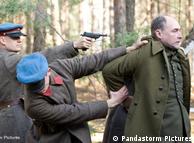
According to the filmmaker Agnieszka Piotrowska, the novel was "described by Arthur Miller and Elie Wiesel as one of the most important books in the so-called Holocaust literature."
Wiesel wrote in The New York Times Book Review that it was: "One of the best... Written with deep sincerity and sensitivity"Richard Kluger, reviewing it for Harper's Magazine, wrote: "Extraordinary... literally staggering ... one of the most powerful books I have ever read" And Jonathan Yardley, reviewing it for The Miami Herald, wrote: "Of all the remarkable fiction that emerged from World War II, nothing stands higher than Jerzy Kosinski's The Painted Bird. A magnificent work of art, and a celebration of the individual will. No one who reads it will forget it; no one who reads it will be unmoved by it. The Painted Bird enriches our literature and our lives "Cynthia Ozick later gushed" – wrote Norman Finkelstein – "that she 'immediately' recognized Kosiński's authenticity as 'a Jewish survivor and witness to the Holocaust'." Time magazine included the novel in its "TIME 100 Best English-language Novels from 1923 to 2005",accentuating the alleged atrocities perceived by the protagonist.
"Perhaps the most surprising element of this aspect of Kosiński's mystifications is that he obtained from his mother, who was still alive in Poland – the father had died by the time The Painted Bird was published – a letter corroborating the claim that he had been separated from his family during the war."
Norman Finkelstein, former professor of political science at DePaul University, wrote in The Holocaust Industry: "Long after Kosiński was exposed as a consummate literary hoaxer, Wiesel continued to heap encomiums on his "remarkable body of work."Finkelstein wrote that Kosiński's book “depicts the Polish peasants he lived with as virulently anti-Semitic” even though they were fully aware of his Jewishness and “the dire consequences they themselves faced if caught.”[7]
The book's reception in Poland was far from uniform nevertheless. The Polish literary critic and University of Warsaw professor, Paweł Dudziak, noted that the Painted Bird is a great, if controversial piece. He stressed that since the book is surreal – a fictional tale – and does not present, or claim to present - real world events, accusations of anti-Polish sentiment are nothing but a misunderstanding of the book by those who take it too literally.
According to Eliot Weinberger, contemporary American writer, essayist, editor, and translator, Kosiński was not the author of the book. Weinberger alleged in his collection Karmic Traces that Kosiński had very little fluent knowledge of English at the time of its writing.
M.A. Orthofer addressed Weinberger's assertion by saying: "Kosinski was, in many respects, a fake – possibly near as genuine a one as Weinberger could want. (One aspect of the best fakes is the lingering doubt that, possibly, there is some authenticity behind them – as is the case with Kosinski.) Kosinski famously liked to pretend he was someone he wasn't (as do many of the characters in his books), he occasionally published under a pseudonym, and, apparently, he plagiarized and forged left and right."
In June 1982, a Village Voice article accused Kosiński of plagiarism, claiming much of his work was derivative of Polish sources unfamiliar to English readers. (Being There, for example, bears a strong resemblance to Kariera Nikodema Dyzmy - The Career of Nicodemus Dyzma, a 1932 Polish bestseller by Tadeusz Dołęga-Mostowicz). The article also claimed that Kosiński's books had actually been ghost-written by his "assistant editors," pointing to striking stylistic differences among Kosiński's novels. The New York poet, publisher and translator,George Reavey, who in Kosiński's American biographer James Sloan's opinion was embittered by his own lack of literary success, claimed to have written The Painted Bird. Reavey's assertions were ignored by the press
The Village Voice article presented a different picture of Kosiński's life during the Holocaust – a view which was later supported by a Polish biographer, Joanna Siedlecka, and Sloan. The article revealed that The Painted Bird, assumed by reviewers to be semi-autobiographical, was a work of fiction. The article maintained that rather than wandering the Polish countryside, Kosiński had spent the war years in hiding with a Polish Catholic family and had never been appreciably mistreated.
Terence Blacker, an English publisher of Kosiński's books and an author of children's books and mysteries for adults, wrote in response to the article's accusations in 2002:
"The significant point about Jerzy Kosinski was that ... his books ... had a vision and a voice consistent with one another and with the man himself. The problem was perhaps that he was a successful, worldly author who played polo, moved in fashionable circles and even appeared as an actor in Warren Beatty's Reds. He seemed to have had an adventurous and rather kinky sexuality which, to many, made him all the more suspect."
D. G. Myers responded to Blacker's assertions in his review of Jerzy Kosiński: A Biography by James Park Sloan:
"This theory explains much: the reckless driving, the abuse of small dogs, the thirst for fame, the fabrication of personal experience, the secretiveness about how he wrote, the denial of his Jewish identity. 'There was a hollow space at the center of Kosiński that had resulted from denying his past,' Sloan writes, 'and his whole life had become a race to fill in that hollow space before it caused him to implode, collapsing inward upon himself like a burnt-out star.' On this theory, Kosiński emerges as a classic borderline personality, frantically defending himself against… all-out psychosis.
The journalist John Corry, being himself a controversial author wrote a 6,000-word feature article in the New York Times in November 1982, defending Kosiński, which appeared on the front page of the "Arts and Leisure" section. Among other things, Corry alleged that reports claiming that "Kosiński was a plagiarist in the pay of the C.I.A. were the product of a Polish Communist disinformation campaign."
The book was published and marketed as a fictional work although it was generally assumed that it was based on the author's experiences during World War II. Only later did it become clear to most reviewers that Kosiński was neither the boy in the story nor did he share any of the boy's experiences, as revealed in a series of articles in newspapers and books.
The depicted events are now widely known to be fictional. D. G. Myers, Associate Professor of English at Texas A&M University, reviewing a biography of Kosiński noted that initially the author had passed off The Painted Bird as the true story of his own life during the Holocaust: "Long before writing it he regaled friends and dinner parties with macabre tales of a childhood spent in hiding among the Polish peasantry. Among those who were fascinated was Dorothy de Santillana, a senior editor at Houghton Mifflin, to whom Kosiński confided that he had a manuscript based on his experiences. According to James Park Sloan, by the time the book was going into publication, Kosiński refrained from making further claims of the book being autobiographical – in a letter to de Santillana and in a subsequent author's note to the book itself.Kosinski nonetheless continued to assert that characterizing the novel as autobiographical "may be convenient for classification, but is not easily justified" (the same language he used in his author's note and his pre-publication correspondence with de Santillana) in later interviews during his life.

