 Between 1871 and 1881, the parson Baring-Gould' of East Mersea
 was the person responsible for the hymn Onward Christian Soldiers. This piece of religious jingoism always seemed to have an element of whistling in the dark about it and it is tempting to think that it was rooted in Baring-Gould's discomfort during his time on Mersea.Baring-Gould became the rector of East Mersea in Essex in 1871 and spent ten years there. In 1872 his father died and he inherited the 3,000 acre (12 km²) family estates of Lew Trenchard
 in Devon, which included the gift of the living of Lew Trenchard parish. When the living became vacant in 1881, he was able to appoint himself to it, becoming parson as well as squire. He did a great deal of work restoring St. Peter’s Church, Lew Trenchard, and (from 1883–1914) thoroughly remodelled his home Lew Trenchard Manor.
 The island was, he complained "Always cold" and he was convinced that living on the marshes had a detrimental effect on the mental capacity of the local people. His feelings may be surmised from the title of his memoir Ten Years on the Mud. Despite setting Mehalah, one of his better-remembered novels, on the island, he was not a popular man hereabouts.
The Essex coast has been described as a ‘bulwark coast’ but one has to wonder how effective a bulwark it has actually been; the Romans far from invading, appear to have been invited over by Adminius to resolve a local dispute in his favour and having seen off Boudicca, they briefly made Colchester their capital, possibly installing sympathetic local rulers. Mersea Island was a retirement community for Roman Officers. The Saxons invaded successfully and in the 10th century, the Vikings made Mersea a military base and bridgehead into the surrounding areas. True an invasion of Colchester was successfully repelled during the 17th century, but it was an invasion of Royalists attempting to relieve the siege of Colchester during the civil war, and it was actually launched from the Island, so I’m not sure that one counts. The Mersea Stone, at the easternmost tip of the island was the site of a Napoleonic fortification, but coastal defences of this era were never put to the test. Neither were the WWii pillboxes still scattered along the shore, and it’s hard to see how these static defences could have been particularly effective given the mobile and highly mechanised force they would have had to contend with. All of which points to the bulwark coast as existing mainly in the imagination – a bulwark of the mind, rather like Onward Christian Soldiers.
Mersea Island was a retirement community for Roman Officers. The Saxons invaded successfully and in the 10th century, the Vikings made Mersea a military base and bridgehead into the surrounding areas. True an invasion of Colchester was successfully repelled during the 17th century, but it was an invasion of Royalists attempting to relieve the siege of Colchester during the civil war, and it was actually launched from the Island, so I’m not sure that one counts. The Mersea Stone, at the easternmost tip of the island was the site of a Napoleonic fortification, but coastal defences of this era were never put to the test. Neither were the WWii pillboxes still scattered along the shore, and it’s hard to see how these static defences could have been particularly effective given the mobile and highly mechanised force they would have had to contend with. All of which points to the bulwark coast as existing mainly in the imagination – a bulwark of the mind, rather like Onward Christian Soldiers.As we pass the stone, we get caught in a sharp sleet storm. We are heading round to the northern and most exposed side of the island, insofar as there’s no shelter from the elments. It's a short squall, heavy enough to soak us but by the time we get to the oyster fishery, the sun is out and we're beginning to dry off. Oysters are of course, another strand of Mersea history going back at least to Roman times. By the middle ages, the monarchy had appropriated the industry, and the right to farm oysters was bequeathed to West Mersea by Edward the Confessor, and to East Mersea, a century or so later, by Richard I. Oysters are sensitive to variations in their environment and the trade has had many fluctuations since then and currently, appears to be relatively flourishing. As we walk past, a boatload is being tranferred to a tractor and taken to the packing sheds. I worked for the oyster company for a couple of weeks one Christmas in the late seventies. In those days, you were picked up by a boat from the hard at Brightlingsea at seven in the morning, and taken to the shed on Peewit Island. The casual labour chipped barnacles from the shells with a hammer and chisel. The skilled workers packed the oysters in straw, into decorative barrels destined, at that time for the markets of Paris. As we walk past the boat, I ask the fisherman for a photo (complete with his dog in the boat) and he is happy to oblige.
This side of the island is farmland, and more typical of the Essex coast in that it lies below sea level behind a wall. The wall does the looping, curvy business which, as we've often noted, means that it is futile to fasten on a spot ahead and attempt to estimate how long it will take to reach. There are few diversions, although I stop to investigate what I think is a cluster of parasol mushrooms, but am not confident enough to pick them, and, as we are approaching the Strood, we disturb a flight of six egrets. This is the longest walk we've done for a few months, the last one at Grays was short, and we are palpably not as fit as we were back in August. Borrowing four horses from a nearby field, we ride bareback into West Mersea. Tethering them outside the library, we retrieve our cars and head for the Peldon and Salcott embassy to plan the next expedition. Ebb Tide engages the ambassador himself in conversation about the Essex Coast, he's familiar with Wallasea, and is a friend of the family who own the boatyard there. He thinks it is the biggest yard in Essex, but we wonder what Maylandsea and Rochford might have to say about that.


 I take some indecent glee in being the first human to post nude photographs of Pussy Galore on the internet. But I hasten to add that from all I know of HB, she’s not going to be ashamed she’s going to think, “Damn, I look pretty good!” Some actor friends of mine have worked with Miss Blackman fairly recently, and reported that she’s still got it (and that’s IT, in the Clara Bow sense).helen mirren


 Stark was born in Norwich, the youngest son of Michael Stark (1748–1831), a Scottish-born dyer .
 He was educated at the Grammar School where he became friends with John Berney Crome. He was then apprenticed to John Berney's father, the landscape artist John Crome, for three years from 1811.
 between 1814–8, winning a prize of £50 in 1818. In 1817 he became a student at the Royal Academy Schools.
 There he devoted himself to painting the scenery around the city and executed a series of paintings of Norfolk rivers which were eventually engraved and published in 1834. In 1821 he married Elizabeth Younge Dinmore (d. 1834/5).
 where he painted many pictures of the scenery along the Thames, but moved back to London in 1849 in order to further his son's artistic education. His only son, Arthur James Stark (1831–1902), born in Chelsea, became a landscapes and animal painter. He drew the cattle on a few of his father's pictures.
 Camden Town, London, in March 1859.

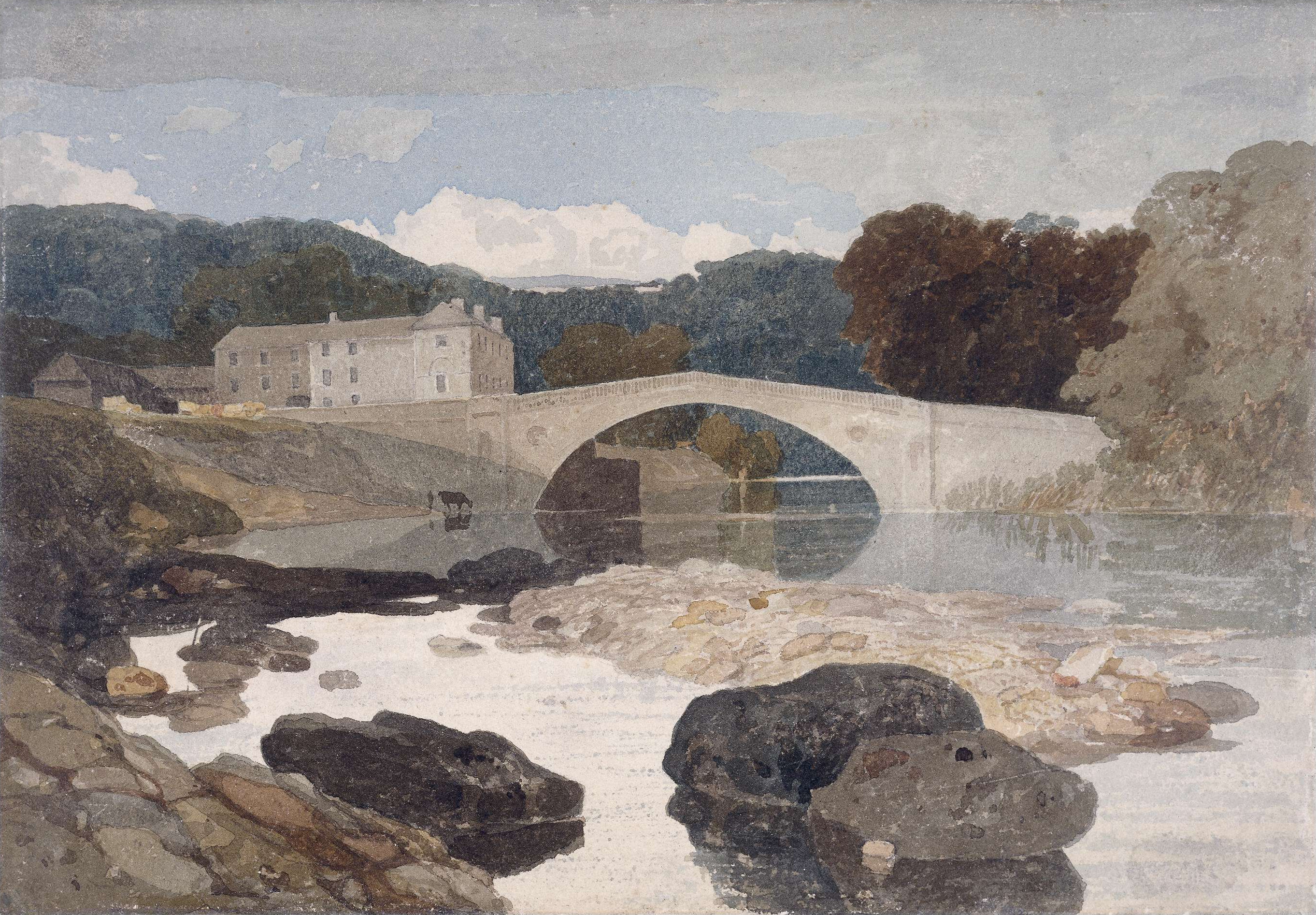
 Crome and Cotman, along with Joseph Stannard,
 established a school of landscape painting which deserves greater fame; the broad washes of Cotman's water-colours anticipate French impressionism.
 masterwork Thorpe Water Frolic of 1828. The Thorpe Water Frolic was an idea of the wealthy merchant Thomas Harvey from his witnessing water-festivities at Venice while on the Grand tour of Europe. Begun in 1824 the Thorpe Water-Frolic attracted crowds of over 30,000 when the population of Norwich was at that time little more than 10,000. A welcome day of rest for the many weavers of Norwich who often worked in cramped conditions, the Water-frolic was enjoyed as a rare day of recreation in the fresh air.
 Drawing every day from a live model, his passion resulted in a collection of nearly 7,000 pages, brought together almost in its entirety at the Musée Rodin. Starting in 1903, the museum organized several exhibitions devoted exclusively to the body of his works in drawing. The Musée Rodin’s ambition is to reconnect with the richness and the breadth of these exhibitions, allowing the public to discover this little-known aspect of his talent.




 Hes like a Harry Enfield character because if you are cool he says "yooooo er crazeeeeeee" . Crazy for the frogolog
  is the highest form of flattery , "Ever ree wun eeees crazeeeeee!!!!!!! yawn yawn yawn yawn
 need a round neck jumper? They got em at asda too lol
 fin de siècle aristocrat famed for his in my opinion we have asda tesco lookalikes below
 debauched themed birthdays: last year Eyes Wide Shut, with topless waitresses; in April,
  very ordinary polos that cost a lot twice a fred perry
 asda I love you

