and her husband
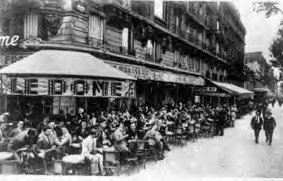
asked us to dine with them at the Dome. It was
freezing during Christmas week. Our studio had a
large coke stove in the back room but, as it was not
one of the kind that burns all night, we had to
break the ice in the sink and the icicles from the tap
each morning. One's toothbrush also had an un
pleasant habit of freezing, and had to be thawed
before use. On Christmas Day I received a little
money from England. We went to the Cafe
Parnasse, in the evening, and waited till twelve p.m.
when we crossed over to the Dome
bright with festoons of coloured paper, and we ate
through an enormous dinner. We got home about
four a.m.

New Year's Eve is a much more lively and serious
festivity than Christmas, as Christmas is a religious
celebration, and the New Year purely enjoyment.
We celebrated the New Year by visiting all the
cafes for miles around with B. and his wife. B.
conducted, with Ortiz, a bull fight at the Parnasse.
B. was the bull and Ortiz the picador. They very
nearly wrecked the place and all the Spaniards
joined in with professional interest. The ladies


BACK TO PARIS AND CELEBRITIES

stood up on seats as the floor was entirely occupied.
At twelve, the lights were turned off for a second and
one kissed or was kissed by one's neighbour.


 In
 In
order to avoid disturbance it was better to be found
at twelve p.m. sitting next to the person that one was
supposed to be kissing. I was sitting in the wrong
place and got into trouble because I was embraced
by quite the wrong person.

I had met once in London, at the Eiffel Tower, a
few months before, a very good-looking young man,
who had been at Oxford. He had told me that he
was coming to Paris, and hoped to get into the
Diplomatic Service. He spoke -French, German,
and Italian extremely well, and suddenly arrived in
Paris from Italy. He had a charming voice and sang
in all three languages. He visited exhibitions with
me, and took to wearing a large black hat, corduroy
trousers, and black sand shoes. This I strongly dis
approved of, as they did not suit him at all, and
finally induced him to abandon them and wear his
ordinary clothes. By this time I had had quite
enough of artistic-looking people, long hair and
shabby clothes, and was only too thankful to be seen
about with a presentable person. Evan Morgan
was still in Paris and knew him well. Aleister
Crowley was there and they were very anxious to
be introduced to him, having heard the most dread
ful stories of his wickedness. Crowley had a temple
in Cefalu in Sicily.
He was supposed to practise
Black Magic there, and one day a baby was said to
have disappeared mysteriously. There was also a
goat there. This all pointed to Black Magic, so (above the original temple now on sale)

people said, and the inhabitants of the village were
frightened of him. When he came to Paris he
stayed in the Rue Vavin at the Hotel de Blois. I
asked him if I could bring some friends to see him
and he asked us to come in one day before dinner
and have some cocktails. He said that he had in
vented a beautiful cocktail called Kubla Khan
No. 2. He would not say what it was made of. I
told Evan and he, I, and two young men went to
try it out one evening. Crowley had only a small
bedroom with a large cupboard. He opened the
cupboard and took out a bottle of gin, a bottle of
vermouth, and two other bottles. The last one
was a small black bottle with an orange label on it,
on which was written " POISON." He poured
some liquid from the large bottles, and then from
the black bottle he poured a few drops and shook
the mixture up. The " POISON " I found out
afterwards, was laudanum. I believe that it is
supposed to be an aphrodisiac but it had no effect
at all on any of us except Cecil Maitland, who was
there also. After we left he rushed into the street,
and in and out of all the cafs behaving in a most
strange manner, accosting everyone he came into
contact with. I introduced J. W. N. Sullivan to
Crowley. They got on very well together, as they
both were very good chess-players and very good
mathematicians as well. I don't think that Sullivan
was much interested in magic, but they found
plenty to talk about. Crowley had taken to painting,
and painted the most fantastic pictures in very bright
colours. He painted a picture about a foot and a

half wide, and nine inches high, of a man on a white
horse chasing a lion. It was very interesting, a
little like the Douanier Rousseau; it had a great
deal of life and action. I would have liked to have
bought it, but I was very broke, and he wanted a
high price for it. He gave me a painting, on a
mahogany panel, of a purple negress, with a yellow
and red spotted handkerchief round her head, and
a purple rhinoceros surrounded by oriental vegeta
tion. The rhinoceros had got rather mixed up with
the vegetation, and it was rather difficult to distin
guish between the trunks of the trees and the
animal's anatomy; it was quite a beautiful colour
however. His wife arrived from Cefalu.
She was a
tall, gaunt Jewess, very thin and bony, with a
strangely-attractive face and wild eyes. She had
been a schoolmistress in New York. She had had a
child by Crowley which had died, and Crowley was
very much upset about it. He showed me a photo
graph of himself and her and some children standing
up to their knees in the sea, with no clothes on. I got
on very well with them. They were very anxious for
me to go to Cefalu. I did not care for the type of
person who clung round Crowley. They seemed so
very inferior to him and so dull and boring that I
could never understand how he could put up with
them. 
Betty May, whom I had known in London in
1914, with Basil, arrived in Paris one day. She
had been one of Epstein's models and one of the
principal supports, with Lilian Shelley, of the Crab
Tree Club, which was started in 1913. I only went
Born in the East End of London, Betty May became the model and muse to the bohemian elite of London. She sat for Augustus John, Jacob Kramer and caught the attention of Jacob Epstein at the Café Royal where they were all "regulars". She was known as the Tiger Woman - because of her party trick: putting a saucer of brandy on her back, on all fours.
Betty May remained the most famous of the many bohemian beauties After a whirlwind romance in 1922, she married Raoul Loveday but their relationship was threatened by her husband falling under the influence of the Satanist cult of Alistair Crowley. She challenged the latter to regain her husband's soul but it was a hollow victory as he died very young
1929 her autobiography Tiger Woman was published from which a film was planned about the life of Betty May, based on this book
This is one of two self portraits Epstein did during his career - the first one in 1916 -a larger than life one, very smooth. This shows the effect of the First World War where he lost so many friends; also the first with a rugged finish - which became a characteristic of his work.
to it once with Basil in 1914. Betty had married
recently her fourth husband, a most brilliant young
man called Raoul Loveday,
 who was only twenty
and had got a first in history at Oxford. He was
very good-looking, but looked half dead. She was
delighted to meet me and we all sat in the Dome
and drank. They were on their way to Cefalu as
Crowley had offered him a job as his secretary. He
was very much intrigued with Growley's views on
magic. He had been very ill the year before and
had had a serious operation. I had heard that the
climate at Cefalu was terrible; heat, mosquitoes,
and very bad food. The magical training I already
knew was very arduous. I urged them not to go.
I succeeded in keeping them in Paris two days
longer than they intended, but they were deter
mined to go and I was powerless to prevent them.
I told Raoul that if he went he would die, and really
felt a horrible feeling of gloom when I said  Good
bye " to them. After five months I had a postcard
from Betty on which was written, " My husband
died last Friday; meet me at the Gare de Lyon."
I could not meet her as I got the postcard a day too
late and she went straight through to London. He
died of fever. There were no doctors at Cefalu and
one had to be got from Palermo, but it was too late
when he arrived. There is a long and very interest
ing description of life in Cefalu in Tiger Woman,
Betty May's life story, but not half so good as the
way in which she told me the story herself.

Cecil Maitland and Mary Butts were very much
interested in Crowley and went to Cefalu. Everyone


in the temple had to write their diary every day
and everyone else was allowed to read it. The
climate and the bad food nearly killed Cecil and
Mary, and when they carne back to Paris they looked
like two ghosts and were hardly recognizable.

Growley came to Paris from time to time. He
gave the appearance of being quite bald, with the ex
ception of a small bunch of hairs on top of his head,
which he twiddled into a point. He shaved the
back of his head and appeared entirely bald. One
fete day I was sitting at the Rotonde and a most
extraordinary spectacle appeared. It wore a mag
nificent and very expensive grey velours hat.
Underneath, sticking out on each side was a mop
of black frizzy hair and the face was heavily and
very badly painted. This I recognized as Growley.
He said, " I am going to Montmartre and I don't


know of any suitable cafes to visit I could not
think of any where he would not cause a sensation,
but I suspected that that was exactly what he
wanted. I told him the names of a few suitable
places and he disappeared. I never saw him in this
disguise again and did not dare enquire whether he
had a successful evening or not. He appeared some
times in a kilt and got howled down by the Ameri
cans, who were rude enough to sing Harry Lauder's
songs at him. He had a passion for dressing up.
One day the Countess A., a Frenchwoman, asked
me to lunch. I had been to her home several times
before and we were becoming very friendly. She
spoke excellent English and had heard about
Crowley, She was most anxious to meet him. I


refused to introduce him to her as she had been very
kind to me and I knew how fond Crowley was of
pulling the legs of people whom he suspected of
being rich and influential. It was a curious kink that
he had which had lost him many opportunities and
people that would have been useful and friendly
to him. It was a kind of schoolboy perversity. A
friend of mine introduced him to her and she asked
him to her house to lunch to meet some distin
guished and rich women who were longing to have
their horoscopes read. I was not at the luncheon
party, but Crowley, I heard, had a great success and
told them all kinds of things about themselves that
they were dying to hear. He looked at the Countess
and said, " I have met you in another life." She
was naturally very intrigued and asked him when
and where, and he said that, in fact, he had written a
story about her that had been published and that he
would send her a copy. This he eventually did and
to her horror when she read it, it was a perfectly
monstrous story, about a perfectly monstrous and
disreputable old woman bearing, of course, no re
semblance to her. She was naturally furious and
refused to see him again. One evening, before the
unfortunate incident took place, a man whom we all
knew, asked us to come to his flat and try a little
hashish. I had never tried any, but only a few days
before, the Irish journalist whom I knew, had told
me about his experiences when he had tried some.
It is not a habit-forming drug and does not do any
one much harm. The Irishman went to see some
friends one day and they gave him some. I believe


that one loses all sense of time and space. It takes
about a hundred years to cross quite a narrow street
and, as Maurice Richardson pointed out when I
told him the story, probably a hundred years to
order a drink. The first effect is a violent attack of
giggles. One screams with laughter for no reason
whatever, even at a fly walking on the ceiling. The
Irishman went through all the stages and finally
decided to go home. He had to walk across Paris
and cross the river by Notre Dame. When he
reached it he found that it was at least a mile high,
and, giving it one despairing look, sat down on the
quays to wait till its size had diminished. He had
to wait for some time, but finally he decided that it
had grown small enough for him to continue his
walk home. The Countess had asked Crowley to
dinner, and he appeared in what he considered to be
suitable evening clothes. He wore black silk knee
breeches, a tight-fitting black coat, black silk stock
ings, and shoes with buckles on them. The coat had
a high black collar with a narrow white strip at the
top. On his chest he wore a jewelled order and at
his side he carried a sword. I asked him what the
order was. He said, " The Order of the Holy Ghost,
my dear." We went to our friend's fiat after dinner.
He had a large pot on the floor which contained
hashish in the form of jam. On the table were some
pipes, as one smoked or ate it, or did both. I tasted
a spoonful, swallowed it, and waited, but nothing
happened. The others got to work seriously and
smoked and ate the jam. I felt no effect except that
I was very happy, much more happy than if I had


drunk anything. I sat on a chair and grinned.
The others entered the giggling stage. This was for
me a most awful bore as I could not say a word of
any kind without them roaring with laughter. I
got so bored that I went home to my Pole. Growley
eventually returned to Cefalu, taking his wife with
him, and so we had no more Kubla Khan No, 2.There was a charming Frenchman who visited
the quarter. He wore a black hat and had curly
black hair which was going grey. He was a very
important person at the Prefecture of Police. He
was a great friend of all the artists in Montparnasse
and bought many pictures from the Polish picture-
dealer. He had several very fine Modiglianis. He
sang old French songs very beautifully, including
one which had been the favourite song of Henry the
Fourth. It was a most charming song and I wish
that I had learnt it. One day I had to visit the
Prefecture of Police about my carte (Tidentite. He
had told me that if I wanted any help to come and
see him in his office. I went one morning and
mentioned his name. I was shown to the office by
several policemen, who were very polite. The door
was opened and, sitting at a desk, was Monsieur S,
looking very unlike a Chief of Police. The walls
were covered from top to bottom with modern
paintings very good ones indeed and for the
moment I completely forgot why I had come. I
had no wish to remember either, as I was much too
interested in the pictures. Unfortunately he was a
very busy man and I had to explain my difficulties
and go away. I tried to know as few English and
Americans as possible, as an evening spent with the
French or the foreign artists, who had known
Montparnasse for years, was very much more enter
taining.
 There was a big man called Ceria, with a
large beard. He was a Frenchman from Savoy. I
always called him Francois Premier, which pleased
him. He painted very well, in fact I found some
pictures of his at the Leicester Galleries the other
day.

Each year the Academic Colorossi gave a fancy
dress ball. In 1920 I did not go. The result was
that neither the Pole nor I had any sleep at all
that night. The Academy was only divided from
our studio by a small garden and the din was awful.
I decided that the next party I should be there.
Although we worked at the sketch class, and at the
Cours libre, we rather despised the art students,
who consisted mostly of silly Americans, French
bourgeois, and imbecile English. Oddly enough the
ball was entirely run by the French, in fact by the
Professor, Bernard Naudin, a funny little man, who
is a very famous illustrator and a great friend of the
Fratellinis 5 , the three famous clowns from the Cirque
Medrano. He was an admirable clown himself and
came to the dance dressed as a comedian. He
brought with him a wooden horse on wheels, which
he dragged behind him on a string. Ceria came
dressed as Edouard Manet, and he looked exactly
like him. He wore a brown square bowler hat and
had grown his beard in the same shape as Manet had
worn his; he had sponge bag trousers and white
spats. He was acting as barman and mixing the


most deadly cocktails. The French still think that
it is very " chic " to spend the whole night drinking
cocktails. I knew only too well what that might
lead to and stuck to wine. I wore my workman's
blue trousers that Basil and I had bought for six
francs


 in the Avenue du Maine in 1914.5 a sailor's
jersey,,
 and espadrilles. We danced and danced,
every kind of dance, jigs, polkas, old-fashioned
waltzes and jazz. I met a most charming woman
whom I had met once before. She was Polish and
a very talented sculptress. She was very ugly, but
with that kind of ugliness which is attractive. I sat
on her lap and told her how much I liked her works.
She was delighted, and we became great friends
afterwards. She had, a few years later, a success in
the
 Salon d'Automne. Naudin did some stunts
with one of the Fratellinis, whom he had brought
with him. We successfully chased any boring
English or Americans away. I was permitted to
join in the fun, as I was of the pre-War brand, and
my Montparnasse and Apache French amused them.
As the night wore on, I remembered more and more
French and finally went home about five-thirty a.m.
feeling very tired.
One day Rupert Doone, the ballet dancer, came
to Paris. He was then just beginning to dance. He
was very poor and had posed for Cedric Morris and
Dobson. He had a very fine head. He sat for the
Academies to make a little money. I wanted to
paint him. I did some drawings of him in my
studio for which I paid him a little, but I could not
afford to give him longer sittings. I introduced him
to the Professor of Colorossi, and he gave him a
month's sitting in the portrait class. The portrait
class had not got a cours libre and one had to have
criticisms from the professor. This amused me as I
had not been taught in an art class for years. I
started a small head which went very well. On
Friday the Professor arrived. I have forgotten his
name, but he is a well known exhibitor at the Spring
Salon. He was a sweet little man with a grey beard;
he stared at me a good deal and gave me a very good
and true criticism. I took his advice and it turned
into, I think, one of my best portraits. It was
bought in 1926 at my Exhibition in London by Mr.
Edward Marsh and is now in his collection.
I had met at theSitwells' house in London, a most
charming South American. He had a large flat in
Paris and one day came to Montparnasse, where he
found me. He had with him Christopher Wood,
who was staying in his flat. He was a very promising
young painter and had been originally discovered
by Alphonse Kahn.I found him a most charming
young man. He had a studio near the Boulevard
St. Germain.I dined with him and we danced at
the Cafe de Versailles.He knew many people whom
I had known in London and we had a very enter
taining evening. He had models in his studio and
asked me if I knew of any good ones.

 I recom
mended Rupert Doone and brought him with me.
We all had lunch at the studio
and afterwards drew.
I am afraid we were very cruel as we wanted a kneel
ing position from the back and Kit tied the unfor
tunate model to the gallery of the studio with a

 Fabrice Moireau
 table napkin, and although the balcony was not very much higher than the model's throne, the strain on his wrists nearly killed him.  We were, however, very satisfied with our drawings. I often went to the studio and drew and did some good work, and also had some very good food and drinks, which more often than not,

rue de Sevres I'm in the irresistable Le Grand Epicerie.
I badly needed. The Pole
knew a certain number of very respectable French and Polish bourgeois friends who came occasionally to have coffee at the Dome and at the Rotonde. One day, things were very bad indeed, and I went to the municipal pawnshop with a ring. There are no pawnshops like those in London, but only the State ones. I entered an enormous building in the
 Boulevard Raspail, that looked like a bank and waited in a queue. I was given a number and
  shown into a large room, where, to my surprise, and to their embarrassment, I found several of the French bourgeois that I knew. Conversation at moments like this is a little awkward, and even I was at a loss to know what to say. I thought that the situation was rather funny, but the poor things were only disturbed. We all sat on benches and, at a little office at the side, our numbers were called out, and at the same time an offer of the price that they were prepared to give. This really was most humiliating and nearly always disappointing. I waited my turn and suddenly my number was called out, " Number 12, thirty francs." Everyone's head turned in my direction and, with a strange feeling in my throat, I said " Out" On another occasion my Pole and another Pole went to pawn a L A
piece of jewellery which had been in before for seventy francs. It had been redeemed and had to go back again. They were given a number and waited their turn. Suddenly the man in the office called their number: " Number 5, eighty francs and they were so delighted and astonished that they both screamed " Out " together in such a loud voice that everyone stared. One day I received a letter from my elderly Canadian cousin, the one who had lived at my Grandmother's flat and thought that I had gone to the devil, when I abandoned corsets at the age of seventeen. I had not seen her for some years. She was living with another elderly lady in a pension near the Luxembourg Gardens. I went to lunch with them. The pension was one of the dreariest that I have ever entered. It reminded me of Balzac's Eugenie Grandet.
 We sat at a long table. My cousin and her friend drank water. Bottles, with table napkins tied round their necks, and names on the labels, were placed on the table belonging to the French. I drank water and had an abominable lunch. After lunch my cousin handed me two one pound notes. I was getting very bored with the ladies and had an inspiration. I said that I had just remembered an important engagement at three p.m. at my studio with a picture-dealer. I arranged to meet them at a teashop in Montparnasse later. I took a taxi and went to the nearest exchange, which was in Montparnasse, where I received quite a respectable number of francs. I went to the Parnasse Cafe, where I bought the boys and girls
 drinks, much to their astonishment and delight. I had some also, and arrived at the teashop in very good form. In Paris teashops wine is sold and generally spirits. It was a very cold day and I told my cousin and her friend that rum was a very good

thing to prevent people from catching cold. I ordered them two hot rums, and they were so pleased that I ordered them two more. They were quite lively and almost human, and I sent them back to their dreary pension feeling very happy.

They had a curious existence, these women, they refused to learn a word of French, and became furious with the French servants because they could not understand what they were talking about. Their whole lives consisted of economizing. They had apparently no ambitions of any kind. They had wasted all their youth, having been taught when young that it was only necessary to behave like ladies and wait till a suitable, and preferably rich husband, turned up. Of course, the husband never did turn up. I often wondered what would become of them if they were suddenly to lose all their money. They toured Europe and wintered at Hyeres, Beaulieu,
 and Bordighera, where they stayed in pensions, with elderly Colonels, Generals, and old women, w r ho were as bored with life and each other as they were. Everyone that I know has at least three or four relatives exactly like mine. They re minded me of my Grandmother, who, for quite thirty years, had patiently awaited death. Anyway, they had given me two pounds and my feelings towards them were of the kindliest. I met, about this time. Ford Madox Ford.
  I had read his books and admired them very much. He talked a great deal and so well that nobody else wanted to, or felt that they could, say anything interesting. He told stories very well indeed. He had most amusing stories about the time that he was in the Welsh Regiment. He learnt to speak Welsh, as many of the soldiers could not speak English. He and Stella bought some of my drawings and were very kind to me. I met Gertrude Stein
 at his house. I had been taken to her studio once in 1914 by Charles Winzer to see her pictures. She was one of the first people to discover Picasso and had a fine collection of his early blue-and-pink pictures. She had a magnificent portrait of herself by him. She was, when I met her again, writing her book, the Making of Americans. I never read the whole of it, but read parts of it in the Transatlantic Review,
 which Ford published later in Paris. I read one chapter on marriage, which I thought a very remarkable piece of writing, and hope to read the whole book one day. I spent in Paris, afterwards, every Christ mas Day, with Ford and Stella. We had Christmas lunch in the Boulevard Montparnasse, at a restaurant called, " Le Mgre de Toulouse''Nowadays Hamnett would need to forgo the cassoulet and make due with pizza, since it has morphed into an Italian spot called padova. "I walked in the early dusk up the street and stopped outside the terrace of the Negre de Toulouse restaurant where our red and white napkins were in wooden rings in the napkin rack waiting for us to come to dinner. I read the menu mimeographed in purple ink and saw that the plat du jour was cassoulet. It made me hungry to read the name".Hemingway
 Ford had a small daughter, and in the afternoon there was a children's tea-party, with a Christmas tree and a real Father Christmas. Ford dressed up as le phe Noel. He looked magnificent as he was very tall. He wore a red cloak with cotton wool representing fur, and a red hood, and large white beard. He appeared with a large sack and spoke French, as nearly all the 1 88 children spoke French better than they spoke English, and Ford's child did not speak English at all. Gertrude Stein nearly always came. These occasions were the only ones when I ever had a chance of talking to her; she was very interesting to listen to, but I always ended by getting into an awful state of nerves. She wore in the winter thick grey woollen stockings and Greek sandals. The stockings had a separate place for the big toe, as the sandals had a piece of leather which went between the big toe and the other four toes. She sat with her legs crossed, and the sandal on the crossed leg dangled and swung from her big toe, to and fro; it never stopped swinging for an instant and ended by nearly driving me mad. The grown-up people drank punch and vermouth, and played snapdragon with the children. I did not like children very much, so sat by the punch -bowl and talked to Gertrude Stein. She used to drive about Paris in a very small and old-fashioned motor-car with a woman friend of hers. Ford gave me a copy of his book, Some Do Not,
 with an inscription inside, on Christmas Day in 1925. Stella painted very well in a very precise and accomplished manner. She did an excellent portrait of Ford asleep. Ford was not too pleased, because she caught him when he had fallen asleep and was snoring with his mouth open. She said that he posed much better when he was asleep. One day Osbert and Sacheverell Sitwell came to see me. I asked them if they would like to come to Brancusi's studio. We went in the after noon and knocked on the door. Inside we heard a noise of approaching footsteps and Brancusi, dressed in overalls, with wooden sabots on, opened the door. He showed us all his work and his photographs, including the Princess., We left after about an hour, all covered in dust, as one cannot sit down in a sculptor's studio without getting covered in plaster and clay. Willie Walton
  was also in Paris, and we all dined together that evening. Osbert said that he would like me to meet a friend of his. Sir Coleridge Kennard,
 who would like to meet Cocteau and Radiguet. Sir Coleridge had a Rolls-Royce, and Osbert said that if I arranged a day they would come to the studio and fetch me. I put on my best clothes and waited, hoping to impress the neighbours, and especially my concierge. I waited behind the front door, but to my bitter disappoint ment they came in an old and very shaky taxi. We went to the Rue d'Anjou, the house of Madame Cocteau,
  Jean's Mother, where he had some rooms to himself. We were shown into a very large room which was filled with all kinds of amusing and wonderful things. On the wall was a portrait of him by Marie Laurencin. A bust of Radiguet, by Jacques Lipschitz, which was very good.
 A portrait of Cocteau by Jacques Emile Blanche, one by Derain, drawings of Picasso, a glass ship in a case, and on the wall by the fireplace,
 himself by, I think,, nearly every celebrated artist in France. We had tea and everyone talked a great deal. I had been taken by Marie Beerbohm to a restaurant in the Rue Duphot, called, La Cigogne,
 and was kept by Moise, an Alsatian, and specialized in foie gras de Strasbourg and hock. Lady Cunard, Stravinsky and all " Les Six " went there very often and, after dinner, they played the piano and danced. I did not know Lady Gunard at this time but I knew her daughter Nancy,
 whom I had met in London. Jean Cocteau and Raymond Radiguet dined there every night.
 It was a very nice, warm, and comfortable place and the foie gras was perfect. One day I met a friend of B.'s, who had been at Oxford.
 He introduced me to a tall and very good-looking young man, who was a great athlete, and had been the champion long- jumper of Oxford. He was six feet-four and asked me out to dinner. He spoke French very well, which is always a great help in Paris, and saved me the trouble of talking to the waiters. I sug gested that we should eat at the Cigogne.
 As we got out of our taxi we saw Jean Gocteau also getting out of a taxi. I said,
 " I would like you to meet my friend, who is an athlete." Cocteau said, " Enchanti; f adore Us athletes" My friend and I had dinner and Cocteau joined us afterwards for coffee. We had a very amusing conversation, as Cocteau can talk marvellously and is not at all a snob and will talk brilliantly to anyone whom he finds sympathetic. I asked the athlete if I could paint his portrait. He lived in a very small room behind the Pantheon, It was in the next street to a street filled with Bal Musettes and in a very low quarter. This I thought very chic and also very economical. I went to his place and painted his portrait. He sat every morning at a table with his hand on a book and a pipe beside him. I liked him very much but found him rather boring after a time. I went out with him and danced. He danced beautifully and was nice and tall. He made great friends with Cocteau, who adored Englishmen. The English are still very highly considered by the French. Principally, I think, because of what Baudelaire said about their clothes. I saw
 Radiguet often with Gocteau. He was a most charming boy and spoke the most beautiful French that I have ever heard spoken. He also spoke very slowly and dis tinctly. He had white, regular teeth and greenish- grey eyes, which were of a very fine shape. His father was a very good draughtsman and worked for a French paper. The best draughtsmen in France, and there are many good ones, are very badly paid and he was very poor/ He had three other children and Raymond was the eldest. Cocteau had met him and thought that he was very talented and Radiguet had become a protege of his. I think, at the time I met him, he was nineteen or twenty. I met also, about this time, for my memory is not quite exact about dates, Georges Duthuit
 , who afterwards married the daughter of Henri Matisse. Georges was very tall and very good- looking and had lived at Oxford. He spoke extremely good English and had large blue ey


 PUDDING GENOESE

Absolutely incredible. Phone companies seem so out of touch. Amazingly these carriers seem to be holding the industry back with their reluctance to expand and invest in infrastructure, the pettiness over 4G, the crazy unrealistic data limits and creative uses of the word unlimited, terrible customer service (you can't even get support in stores any more which is utterly infuriating). It's a joke.